During the Kamakura period, the kosode rose in prominence from an underlayer to the basic garment of everyday life. It dominated Japanese fashion for hundreds of years before evolving into the kimono in the late 1800s.

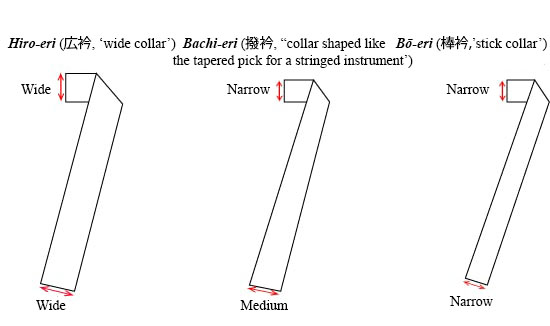
Characteristics of medieval kosode as compared to modern kimono
| Kosode | Kimono | |
| Collar (eri) | Collar is usually knee-length (even for knee-length garments) and full width (hiro-eri, 5-6″ folded in half for wear), no collar protector (kake-eri) | Collar is hip length when belted, hiro-eri for women’s kimono, bachi-eri for women’s yukata, bō-eri for men and children |
| Gore (okumi) | Usually cut as a trapezoid, sewn as a triangle | Cut as a rectangle, sewn as a rectangle with a tapered corner |
| Sleeves (sode) | Usually curved, usually no underarm hole (children’s garments are an exception), usually unisex, stay out of the way because of curvature and closed underarm, 6-9″ wrist opening | Sleeves are completely squared or just slightly curved, open underarm on women’s, need to be tied up to do physical work, 8-9″ wrist opening |
| Body (migoro) | Loose and comfortable, can move easily and sit cross-legged | Slender, fitted silhouette tighter than the katabira shown below, extra long on women (intended to be belted shorter), can’t take long steps, must sit with knees together |
“袖幅が狭いのに対して身幅が広い (Sodehaba ga semai no ni taishite mihaba ga hiroi): The body width is wide in contrast to the narrow sleeve width.
襟肩あきが狭い (Eri kata aki ga semai): The slit cut in the shoulder peak to insert the collar is narrow.
衽下がりが少ない (Okumi sagari ga sukunai): The distance from the shoulder peak to the top of the front overlap panel is small.
立棲が短い (Tatesuma ga mijikai): The distance from the bottom of the collar to the hem is short.
衽幅が広い (Okumihaba ga hiroi): The width of the front overlap panel is wide.
後身幅と前身幅とがほとんど同寸法 (Ushiromihaba to maemihaba to ga hotondo dōsunpō): The back body width and front body width are almost the same size.
裄が短い (Yuki ga mijikai): The distance from the center back of the neck to the wrist is short.
袖口が狭い (Sodeguchi ga semai): The wrist opening is small.”
-Tokugawa Ieyasu no Fukushoku/The Clothing of Tokugawa Ieyasu
The images below show the two most common kosode patterns among the middle and upper class: the standard, everyday silk kosode and the katabira (an unlined summer or bath garment most often made from hemp or ramie). The difference between the two is defined by the ratio between the body width and sleeve width, so if you care about historical accuracy, please don’t alter that ratio when resizing the pattern! Another element of particular importance is sleeve shape; these garments are literally defined by their sleeve. Kosode (‘small sleeve’), tsutsusode (‘tube sleeve’), funazokosode (‘boat bottom sleeve’) and many similar garment names demonstrate a consistent pattern in which garments are largely defined by their sleeve shape.
Keep in mind that any change in panel width is multiplied in each piece of the sewing pattern, so increasing the panel width by one inch would increase both the finished wrist-to-wrist distance and the waist measurement by four inches . This is the reason these two seemingly similar patterns produce significantly different garments. Naturally, when you wear multiple layers, the looser garments need to go on the outside; this is why undergarments typically use a 1:1 ratio, but dōbuku (coats) normally use 1:1.7 instead.
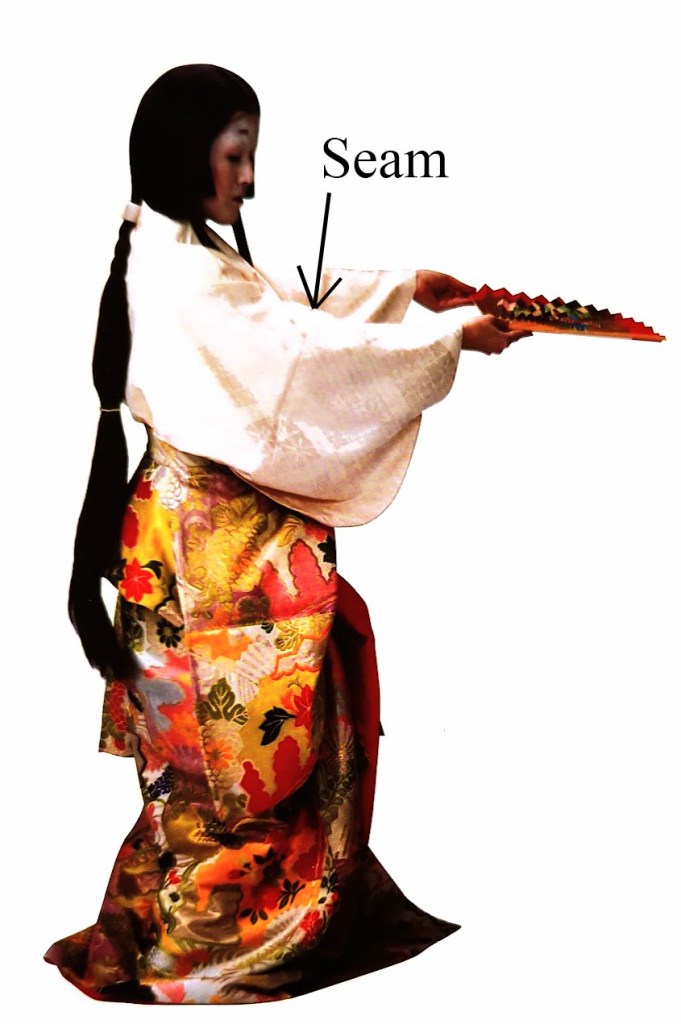
For the katabira pattern (1:1), the shoulder seam falls in the middle of the upper arm., For the typical kosode pattern (1:1.7), the shoulder seam falls at the elbow. Yes, you heard that right – check out the images below. This is a primary feature of upper class garments. Middle class kosode typically use the 1:1.7 cutting layout but a shorter wrist-to-wrist distance, producing a loose body with sleeves that stay conveniently out of the way.

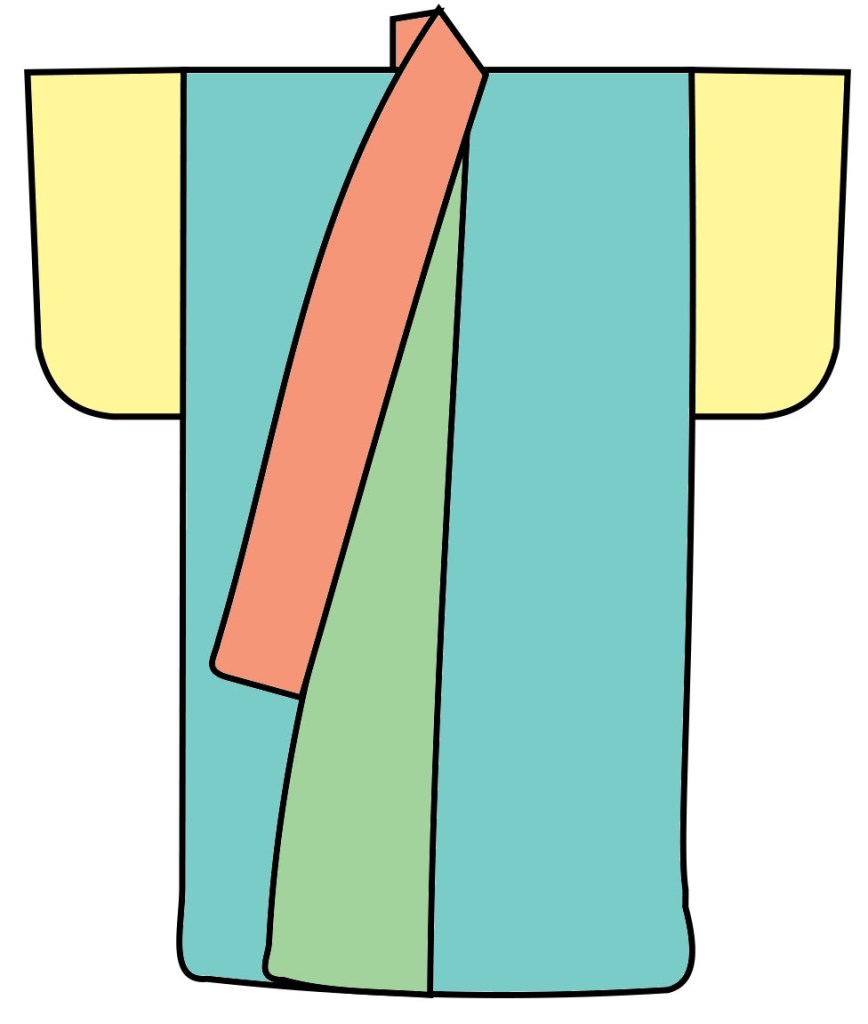

Note: The center lines shown in the body and sleeve panels are the shoulder fold.


Basic katabira pattern (body width = sleeve width: used for garments made from ~35 cm (~14 inches) wide plant fiber fabric such as undergarments, katabira, and peasant wear. Note that while the gores are cut as rectangles, the stitching lines are not parallel to the edges of the fabric, giving the approximate appearance of a long triangle in the finished garment. This layout is similar to that of a modern kimono, except that the katabira uses one long collar piece, and the kimono cuts that length into a shorter collar plus a collar protector.
Basic measurements for ankle-length garment:
- Final garment height from shoulder to hem = your height from floor to shoulder (allows extra length for hem and shortening due to belting)
- If shortening kosode to calf-length for use under hakama or for lower-class garments, calculate measurements for ankle-length version first, then shorten body and gore panels only.
- Final garment width from wrist to wrist: base this on a simple garment you already have, such as a bathrobe or t-tunic (do not measure your arms directly!)
- Shorten to lower forearm length for middle-class, lengthen to partly cover the hands for upper-class.
Kosode pattern dimensions: (Tsukime’s spreadsheet)
- Body: cut two, length = garment height x 2 (shoulder fold), width = 1/3 of garment width
- Gores: length = 95% of garment height, width = 1/3 of garment width
- place dots at 40% up one side and 40% down the other, and cut the resultant diagonal to make two gore
- Sleeves + collar = 163% of garment height, width = 1/3 of garment width
- Cut collar (40% of width)
- Cut remaining length in half to make two sleeves
- Optional: if you would like the collar to be lined, cut an extra collar from a different fabric
Katabira pattern dimensions: (Rei’s spreadsheet)
- Body: cut two, length = garment height x 2 (shoulder fold), width = 1/4 of garment width plus 6 inches (8 seam allowances)
- Gores + collar: 184% of garment height
- Cut collar (40% of width)
- Cut remaining length in half to make two gores
- Sleeves: 142% of garment height
- Cut length in half
- Optional: if you would like the collar to be lined, cut an extra collar from a different fabric.
If you’re allergic to math or in a real hurry, the video here shows a simple method for creating a katabira pattern. It’s a vertical variation on the traditional method, which involves folding the fabric bolt back and forth on a flat surface.
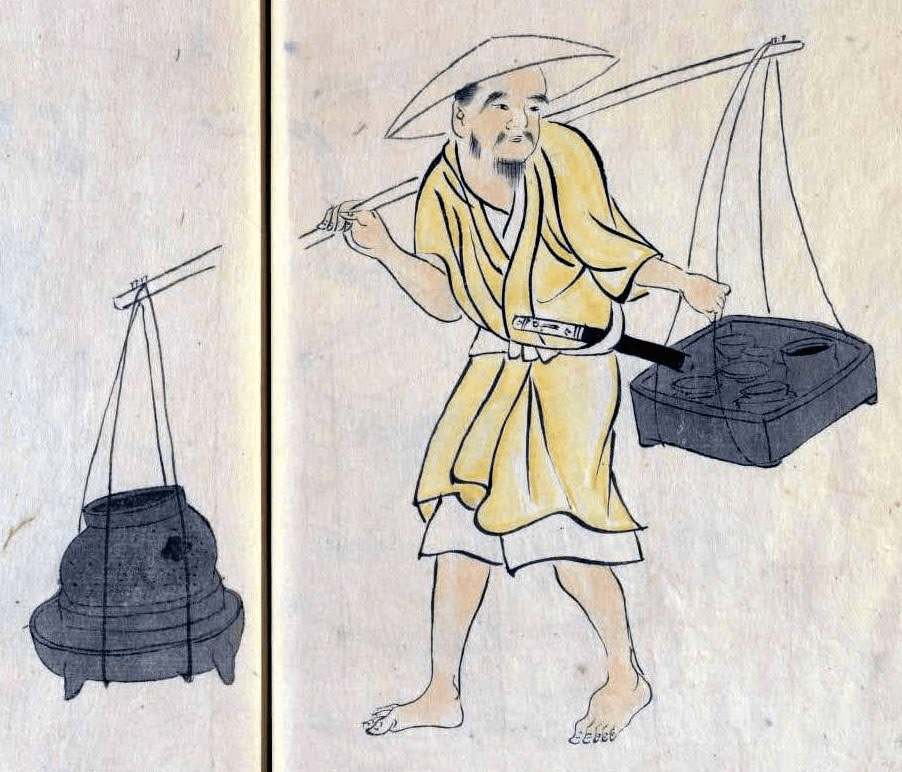
Kosode intended for physical labor use the same cutting layout as the katabira, but all the pieces are shortened, and the sleeves are sewn as utilitarian tubes rather than being curved to provide pockets. Note that the collar is still almost as long as the garment because it’s cut from the same width as the overlap panels.
Image from 32-ban Shokunin Utaawase-e.
Once you have the measurements of the pieces you need, you can design a pattern layout based on your fabric width, and the pattern layout will tell you how much fabric you will need of that width (don’t buy the fabric until you make the pattern layout!) Once your pattern pieces are cut, please continue using one of the kosode construction tutorials (unlined for summer/undergarments, lined for spring/fall, padded for winter).
For a more detailed look at the elements of the kosode, check out my class.
For photos of extant and reproduction pre-1600 kosode, check out my Pinterest board.
Reproduction women’s kosode sorted by time period from the Kyōto Dyeing and Weaving Festival.
References:
- “Cultural Heritage Online”. http://bunka.nii.ac.jp/ Accessed 3/28/18.
- Horikoshi, Sumi. Shiryō Nihon Ifuku Saihōshi. Tōkyō: Yūzankaku Shuppan, 1974.
- Kirihata, Ken; Hiromi Ichida. Shashin de miru Nihon no josei fūzokushi: Kyōto senshoku matsuri kinen zuroku. Kyōto-shi: Kyōto Shoin, 1985.
- Kurihara Hiro and Kawamura Machiko. Jidai Ishō no Nuikata. Genryu-sha Joint Stock Co. Tokyo: 1984.
- “Kyoto Costume Museum”. http://www.iz2.or.jp/english/ Accessed March 10, 2017.
- Nagasaki, Iwao. “A Study on ‘White Cotton Kosode with Design of Horizontal Stripes Owned by Masuda Genosho’ (Private Collection): The actual situation of cotton use by upper-class samurai class in the Azuchi-Momoyama period to early Edo period.” Bulletin of the Faculty of Home Economics, Kyoritsu Women’s University. Volume 69, p. 1-20, Publication date 2023-01.
- Stinchecum, Amanda. Kosode: 16th-19th Century Textiles from the Nomura Collection. Japan Society and Kodansha International, New York and Tokyo, 1984.
- “Tōkyo National Museum”. http://www.tnm.jp/ Accessed 10/14/17.
- Tōkyō Kokuritsu Hakubutsukan. Nihon no Bijutsu #67, Kosode: Traditional Japanese Dress. Tōkyō-to: Shibundō, 1966-.
- Tōkyō Kokuritsu Hakubutsukan. Nihon no Bijutsu #435, From Kosode to Kimono. Tōkyō-to: Shibundō, 1966-.
 旦暮庁 TANBO-CHŌ

Leave a reply to Kosode Measurement Calculator – 旦暮庁 TANBO-CHŌ Cancel reply