Preface
This is the second entry in the article series about Japanese lanterns. This information is from an SCA Arts & Sciences competition entry. This section is the first appendix to the entry and contains a list of observations about basket style lanterns from an entry in the arts journal “Nihon no Bijutsu” (Arts of Japan).
Appendix A: Notes from Nihon no Bijutsu Listing
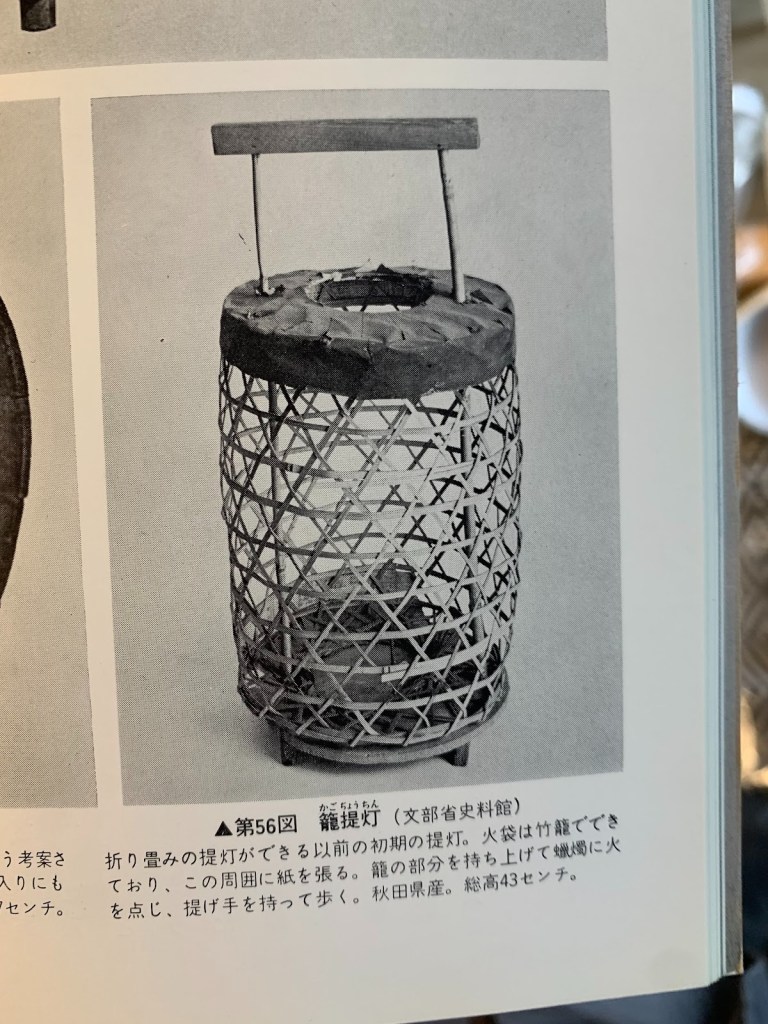
This is a collection of observations about the lantern shown in Nihon no Bijutsu 3, No. 58
Translation of Caption Text
Figure 56: Kago-chouchin (Ministry of Education Archives)
A lantern from the days before there were any folding lanterns made. The firebox is contained within a bamboo basket and paper is affixed around the outside. The basket portion can be raised by hand and the candle can be lit, and then it can be carried by the handle. Made in Akita Prefecture. Total height 43 cm (~17 in.)
List of Observations
- The basket is indeed woven of strips of bamboo. On the walls at least, they are clearly woven in an offset hexagonal pattern called “kagome” (which unhelpfully translates to “Basket eye weave.)
- The horizontal strips of the basket all have significant overlapping portions in their length. This probably prevents the basket from unwinding under pressure. They overlaps are also offset from each other which likely prevent a sort of “seam” from developing where tension could undo the basket.
- The bottom row ring is plaited around itself all along its length. This probably provides extra strength along the bottom shoulder of the basket wall where it transitions to the floor of the lantern and a different weave. While the top portion is covered, it is likely that the top shoulder has a plaited ring as well.
- The bottom of the basket is not arranged in a kagome weave. Rather, it uses a simpler over-under weaving pattern to create a sort of iris effect where the center area of the bottom is empty and a candle or oil lamp could be easily placed. Again, despite being covered, the top of the basket very likely has the same pattern.
- The top of the lantern is covered on the outside. While this originally appeared to perhaps be some kind of clay, further investigation shows that this is almost certainly washi-paper, as confirmed by the caption. A seam appears at the top shoulder of the basket so it would appear that the top of the basket was covered and then a strip of paper was glued to the outside perimeter.
- The paper at the top of the lantern appears opaque, as details of the underlying basket structure cannot be seen apart from the faint impressions of the bamboo strips on the paper where it is glued together.
- There is a hole in the center top of the basket. This opening leaves ample space for air flow in and out of the lantern and prevents the inside top of the paper from being burned or stained with candle soot.
- Near the bottom shoulder of the basket, at the back side, more paper has been attached to the outside of the basket. As with later chouchin designs. The use of washi paper on the outside of the basket allows for light diffusion and protection from cross breezes when the lantern is lit. It is difficult to tell if this paper is opaque or more translucent as one might expect from plain white colored washi.
- The strips that make up the basket are fairly thin. They are probably between ⅛ and ¼ inch (3-5 mm?) wide.
- The base of the lantern is made of a round disc of wood which is probably about ¼” thick. There appear to be two strips of wood perpendicular to the disc forming feet for the lantern. These seem like they are probably also perpendicular to each other, forming a cross shape to provide extra structural integrity to the disc.
- The basket is not evenly arranged atop the base and hangs over one side more than the other. Therefore the posts do not seem to go through corresponding (radially opposite) holes in the weave of the bottom of the basket. It also seems likely that they are not going though equivalent holes in the top of the basket either, and whichever holes they are going through in the top and bottom also may not correspond to each other. The threading of posts through the basket then, is likely based more on necessity of function than strict aesthetics.
- There are two posts attached to the base and handle of the lantern. These appear to be simple stalks of bamboo, based on the presence of several nodes up and down each post. It is unclear from the picture or description exactly how the posts are secured to the rest of the frame, but it seems likely that either holes or small mortises have been dug into the base (and probably handle) to allow the posts to fit in while they are also glued in via rice starch paste.
- The posts themselves do not seem to be all that straight. They maintain the natural shape of the bamboo. This argues that the lantern was constructed for lower class consumers and/or with the aesthetic principles of wabi-sabi design in mind.
- The handle is a cross piece linking the two posts together at the top of the frame and stopping the basket from being removed from the frame. The handle is situated directly over the hole in the basket, which would itself be over whatever flame was providing light for the lantern. It seems likely that the height of the lantern frame was considered tall enough that the handle was sufficiently removed from the heat of the flame that neither the handle nor the holder’s hands would be burned during use.
- It is very difficult to tell, but there appear to be small dark spots in the handle of the lantern directly over where the posts meet the handle itself. These might indicate cross pegs of some sort to hold the posts in place, but it would be difficult to tell that conclusively from just this picture.
- It is also difficult to conclusively say, but it looks like this lantern may have a small spike protruding upward from the base disc as a place to put a candle.
- Because the Journal notes that the entire construction is 43 centimeters in height, some visual proportion analysis leads to a (very!) rough estimation that the basket could be about 8 inches in diameter at the base, and around 11 inches tall.
Series Links
This article is one of a series about this subject. These are the individual posts.
 旦暮庁 TANBO-CHŌ
Leave a comment