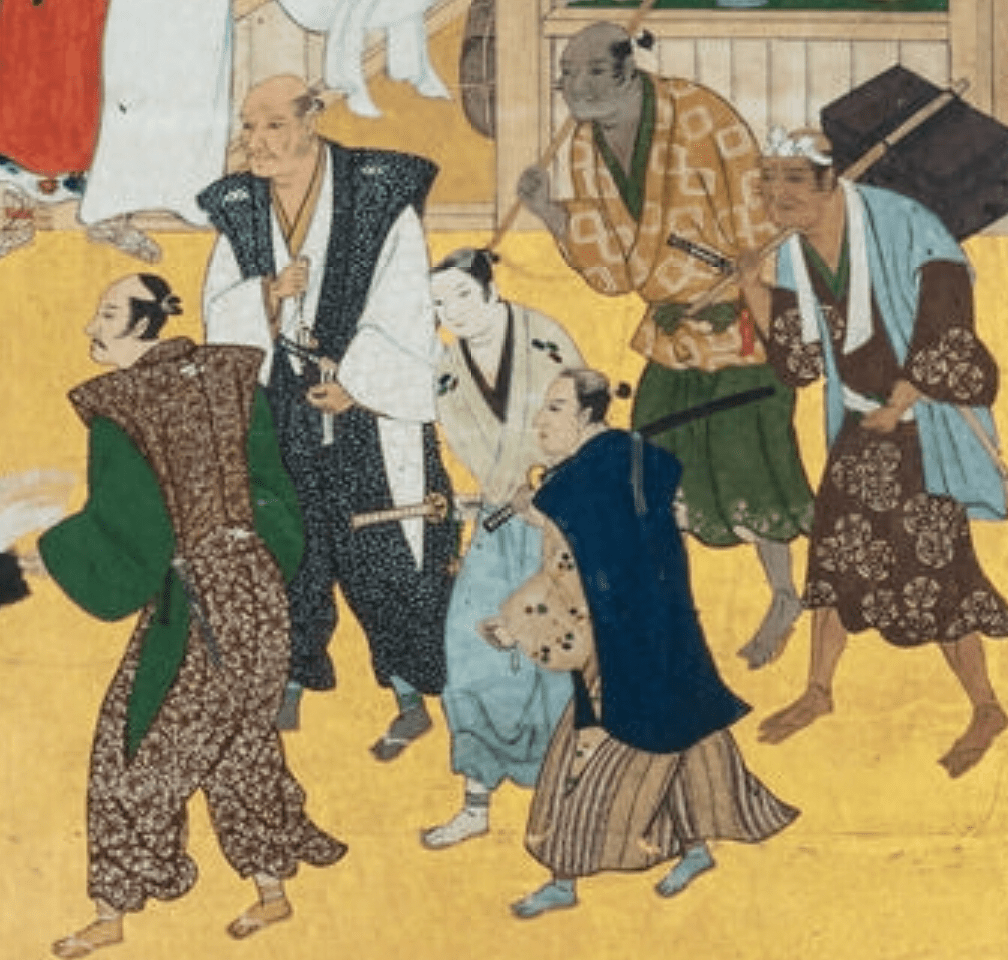
When researching historical Japanese fashions, it is essential to look at images from contemporary sources. Here is a list of artworks depicting people engaged in everyday life which has been sorted by time period.
Any title including the word shokunin, meaning ‘artisan’, shows commoners engaged in their professions. Some of the works are copies of the original which add color to images that were originally black and white.
The Pictopedia volumes linked here are particularly valuable because they offer commentary on the images and an assessment of historical reliability (for example, if an 11th century scroll is depicting events from the 8th century, a comparison to other works can confirm that the fashions shown are from the 11th century).
Image: Nanban Zu Byōbu
Asuka-Nara Periods (538–794)
- 622: “Tenjukoku Embroidery“, Tenjukoku Shūjō (天寿国繍帳)
Heian Period (794-1185):
- Pictopedia of Everyday Life in Medieval Japan, Vol. 1 contains annotated excerpts from Senmen Koshakyō, Ban Dainagon Ekotoba, Chōjū Giga, Shigisan Engi, Gaki Zōshi, and Kitano Tenjin Engi.
- 1100s: “The Tale of Sumiyoshi“, Sumiyoshi Monogatari Emaki (住吉物語絵巻)
- 1100s: “The History of Mount Shigi“, Shigisan Engi Emaki (信貴山縁起)
- 1100s: “The Tale of the Monk Saigyō”, Saigyō Monogatari Emaki (西行物語絵巻)
- ~1130: “Illustrated Tale of Genji“, Genji Monogatari Emaki (源氏物語絵巻)
- late 1100s: “Fan-shaped Lotus Sutra Booklet“, Senmen Koshakyō (扇面古写経)
- ~1177: “Ban Dainagon Picture Scroll“, Ban Dainagon Ekotoba (伴大納言絵詞)
Kamakura Period (1185-1333):
- Pictopedia of Everyday Life in Medieval Japan, Vol. 3 contains annotated excerpts from Kokawadera Engi, Saigyō Monogatari Emaki, Kibi Daijin Nittō Ekotoba, Bai Sōshi, Taima Mandara Engi, Ise Shinmeisho Uta Awase Emaki, Obusuma Saburō Ekotoba, Tengu Sōshi, and Ishiyamadera Engi.
- Mid 1100s: “Illustrated Tale of the Heiji Civil War“, Shihonchoshoku Heijimonogatari Ekotoba (紙本著色平治物語絵詞)
- Late 1100s: “The History of Kokawa Temple“, Kokawadera Engi Emaki (粉河寺縁起絵巻)
- 1219: “The History of Kitano Tenjin Shrine“, Kitano Tenjin Engi Emaki (北野天神縁起絵巻)
- ~1242: “History of the Taima Mandala“, Taima mandara engi (当麻曼荼羅縁起)
- 1300s: “The Biography of the Monk Hōnen“, Hōnen Shōnin Eden (法然上人絵伝)
- 1300s: “Tōhoku-in Artisan Poetry Contest“, Tōhoku-in Shokunin Uta-awase Emaki (東北院職人歌合絵巻)
- ~1261: “Tsuruoka Hojo-e Artisan Poetry Contest“, Tsuruoka Hojo-e Shokunin Uta-awase Emaki (鶴岡放生会職人歌合絵巻)
- 1293 (under some debate): “Illustrated Account of the Mongol Invasion“, Mōko Shūrai Ekotoba (蒙古襲来絵詞)
- 1299: “Illustrations of the Monk Ippen“, Ippen Hijiri-e (一遍聖絵)
- Pictopedia of Everyday Life in Medieval Japan, Vol. 2 contains annotated excerpts from Ippen Hijiri-e, but unfortunately only seems to be available in hard copy.
- 1309 but depicts events spanning Heian and Kamakura periods: “Miracles of the Deity of Kasuga“, Kasuga Gongen Genki E (春日権現験記絵)
- ~1325: “The History of Ishiyama Temple“, Ishiyamadera Engi Emaki (石山寺縁起絵巻)
Muromachi Period (1336-1573):
- Date debated, intended to depict an event in 1410: “The Ashikaga Shōgun’s Visit to Wakamiya Hachiman Shrine“, Ashikaga Shōgun Wakamiya Hachimangū Sankei Emaki (足利 書軍 若宮 八幡具 参詣 絵巻)
- 1494: “32-Artisan Poetry Contest”, Sanjūniban Shokunin Uta-awase Emaki (三十二番職人歌合絵巻)
- Early 1500s: Scenes in and Around the Capital, Matsuda version“, Matsuda-bon Rakuchū Rakugaizu Byōbu (洛中洛外図屏風歴博甲本)
- Copy of a work from the early 1500s: “Sake and Rice Debate“, Shuhanron Emaki (酒飯論絵巻)
- 1517: “Illustrated Origins of Kiyomizu Temple”, Kiyomizu-dera Engi Emaki (清水寺縁起絵巻)
- ~1550: “71-Artisan Poetry Contest“, Shichijūichiban Shokunin Uta-awase Emaki (七十一番職人歌合絵巻)
- Commentary on the images
- Full text
Momoyama Period (1568-1600):
- ~1570: “Maple Viewers” Kanpūzu Byōbu, (観楓図屏風)
- 1574: “Scenes in and around the Capital, Uesugi version“, Uesugi-bon Rakuchū Rakugaizu Byōbu (上杉本洛中洛外図屏風)
- “Southern Barbarians“, Nanbanzu Byōbu (南蛮図屏風)
- “Merrymaking Under the Blossoms“, Kakayū Rakuzu Byōbu (花下遊楽図屏風)
- “Horse Training” Bokubazu Byōbu (牧馬図屏風)
- “Castle Construction“, Chikujōzu Byōbu (築城図屏風)
- “Customs of the Twelve Months“, Jūni Kagetsu Fūzokuzu (十二ヶ月風俗図)
- “Watching Noh“, Kannōzu (観能図)
If you have any other favorites you’d recommend, email me!
 旦暮庁 TANBO-CHŌ

Leave a comment