
This spreadsheet will custom-size the standard kosode pattern used by the Muromachi and Momoyama period middle and upper class regardless of gender. It is generous in cut, making it an excellent choice for larger individuals and a poor choice if your primary concern is using minimal yardage. No, you really don’t need to enter your waist size – it is designed to fit loosely and be folded and belted down to size. The pattern works for waist sizes up to 60 inches/6XL.
This garment is designed to fall to the wrists and ankles, and the spreadsheet will not work correctly if you attempt to shorten it to the knees or elbows. If you’re looking for a narrower garment, please check out Rei’s katabira pattern spreadsheet in the Kosode Patterns post.
When estimating your wrist-to-wrist distance (2 x yuki, if you’re familiar with kimono terminology), the best way to find your size is to measure a garment such as a bathrobe that fits you well. Measuring a garment is both easier and more accurate than trying to measure your arm length. Err on the long side, because you can always take it in by increasing the size of the side seam allowance. Similarly, a deep hem will help the garment’s drape, so overestimating length is also a good thing.
Image: recreation of Izumo no Okuni, the founder of kabuki, from the Festival of Ages in Kyо̄to. Wikimedia Commons.
To give an example of the range of sizes:
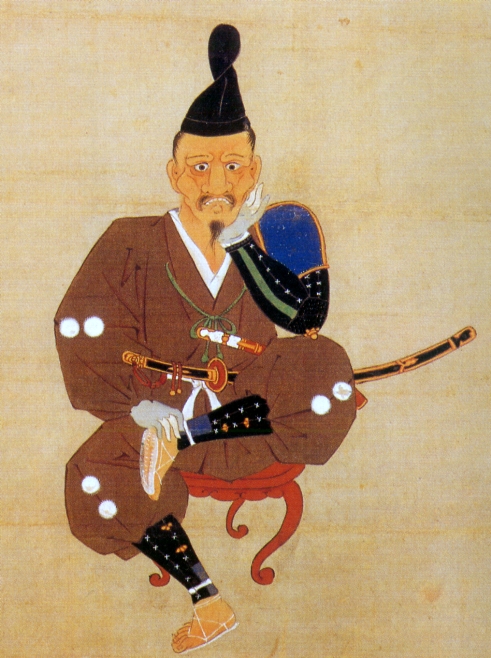
Tokugawa Ieyasu was 157 cm tall, based on his mortuary tablet at Daijuji Temple and confirmed by comparison with his armor.
His extant kosode range in length from 129.5-140.5 cm long, with a median of 136.6, and their yuki range from 50.5-66cm (101-132 cm wrist to wrist), with a median of 60.6.
From this, we can estimate that:
- the finished length of the kosode from shoulder to hem should be 82-90% of your height (most often 87%)
- the finished width of the kosode from wrist to wrist should be 64-84% of your height (most often 77%)
It is a reasonable assumption that kosode intended for casual wear would be on the shorter end of the size range in both respects, and formal garments would be more voluminous.
Image: Tokugawa Ieyasu after the Battle of Mikatagahara, Wikimedia Commons.
References:
- Fukushima, Masako. Tokugawa Ieyasu no Fukushoku. Chūōkōron Bijutsu Shuppan: Tōkyō, 2018.
- Nihon no Bijutsu 67. Shibun-dō: Tōkyō, 1966-.
 旦暮庁 TANBO-CHŌ


Leave a comment