Obi (帯, ‘sash/belt’) before 1600 were usually narrow fabric ties worn around the waist. They tended to be narrower and less stiffened than modern kimono obi, making them less restrictive and easier to tie. However, they did often have a core (interlining) made of plain fabric (typically hemp or silk) in addition to the fabric visible on the outside. This core is visible on damaged extant examples, and gives them more body than a simple fabric tube.
Types in approximate order of popularity
(far from a complete list, made from woven fabric sewn into a tube unless otherwise noted, names for the same type can vary significantly)
- Hoso (細, ‘narrow’) obi: most commonly seen, tied around the waist of the outermost torso garment
- Omi (御身, ‘body’) obi: soft utility tie used to secure underlayers, called koshihimo (腰紐) today
- Hakama-shita (袴下) obi: wide and sturdy, specifically used under hakama and for supporting swords, evolved into today’s kaku obi, white for underlayers, colors and patterns if visible
- Uwa (上, ‘over’) obi: utility, solid color, tied on over armor, various forms (sewn tube, unsewn length of fabric, padded tube, braided cord)
- Kake (掛, ‘hanging’) obi: always red, tied around the chest of a female pilgrim
- Katsura (鬘, ‘wig’) obi: tied around the head to secure a headpiece
- Nagoya (名護屋) obi: braided rope style imported from Korea, considered exotic and flamboyant, typically seen in social groups with unusual fashions like courtesans and kabukimono
- Hira-gumi (平組, ‘flat braid’) obi: wide braid often made on the karakumidai frame, thought to have been used during Nara period
- Hirao (平緒, ‘flat strap’): wide karakumidai braid, often purple and white, used for men’s court wear
Measurements varied significantly, but typical hoso obi dimensions for the middle to upper class were one to three inches wide (2.5-7.5cm) by three yards (~274cm) long and went around the body twice (see table of extant obi dimensions). Obi intended to be worn under hakama (pants) were typically stiffer and wider, around 4”. Written references to obi in early Muromachi often describe them as ‘a width of cloth divided by 6’, and in late Muromachi/Momoyama, ‘divided by 8’. It is difficult to be sure of the exact dimensions, since bolt width varied widely (often 14” for hemp, 17” for silk), and we don’t know whether they included seam allowances in that math. But to give examples, 14”/6 = 2.3”, and 14”/8 = 1.75”, 17”/6 = 2.8”, and 17”/8 = 2.1”.
Fabrics for hoso obi were often re-purposed from other garments. As far as color coordination, we see examples of contrast colors, multicolored obi that go with anything, and the assumption that red or reddish-orange goes with anything (though this is often a brocade or stripe rather than solid red).
| Lower class | Middle class | Upper class |
| Usually solid color plant-fiber fabric such as hemp or ramie | Usually silk using basic decoration such as woven stripes, stenciling, or resist dye (shibori, katazome, surikomizome) | Usually fancy silk such as brocade (karaori, nishikiori) or a combination of shibori, ink painting, gold leaf, and embroidery (tsujigahana) |
How to tie: Children and unmarried youths would generally tie the hoso obi in back, while adults usually tied it in front. Women sometimes tied on the side, according to the fashion of the day. Hakama-shita/kaku obi are tied in the back, and form a small shelf that prevents the hakama from slipping down. Instructions on tying a standard (shoelace) bow, square knot, and half bow are readily available in English. More complicated knots are sometimes most easily learned from a video like the ones shown below.
Obi knots: musubi (結び) (Common types, many other variations were used)
- Chō (蝶, ‘butterfly’): basic shoelace bow
- Kōma (駒, ‘colt/foal’): basic square knot; fighters and laborers sometimes tucked loose ends up or wrapped them around the knot to minimize dangling
- Katawana (片わな, ‘one-sided’): half bow; good for quick release, used for nagabakama (long, often red women’s undergarment hakama); still used for tying kimono underlayers today
- Taira (平, ‘flat’): popular for wide underlayer ties (shita-obi)
- Ichimonji (一文字, ‘number one-shaped’, where the Japanese number one is a horizontal line): obi used under hakama, Momoyama period samurai
- Twist: I have not seen this listed as an official musubi type, but we see twisting used to secure underlayers without the bulk of a knot
 |
| For ichimonji musubi, I would recommend this YouTube video. It includes tying the initial obi knot, tucking up the hem, and anchoring the hakama ties on the obi knot. Rather than tying the hakama with a jūmonji (‘number ten / 十-shaped’) knot, use a bow, square knot, or ichimonji. |
 |
| For taira musubi, you can use this video without alteration. |
Examples:
 |  |  |  |
| Heian period nobleman, hakama-shita obi tied using taira musubi, from Jidai Ishо̄ no Kitsuke | Kamakura period noblewoman, hoso obi tied in katawana musubi, from Jidai Ishо̄ no Kitsuke | Muromachi period samurai, hitatare undergarment hakama ties secured with a twist, from Samurai: Arms and Armor | Momoyama period Christian samurai in kaku obi tied using ichimonji musubi, from Samurai: Arms and Armor |
The Muromachi period images shown here are later re-colorings of their original images, but the color is still plausible, if not documented by a contemporary source.
 |  |  |
| Laborer whose obi is not visible but is most likely solid color hemp, Muromachi period. Image from 71-ban Shokunin Uta-awase-e. | Artisan (shokunin) cutting plaid, resist-dyed, and stenciled hoso-obi using a knife, Muromachi period. Image from 71-ban Shokunin Uta-awase-e. | Noblewoman with a gold-leaf hoso-obi, Momoyama period. Image from Wikimedia Commons. |
 |  |  |
| Laborer with an undyed hoso–obi tied in chō musubi, Muromachi period. Other solid colors were used, especially blue and brown. Image from 32-ban Shokunin Uta-awase-e. | Townsperson (chōnin) with a solid-colored hoso–obi tied in katawana musubi, Keichō period (1596-1615). Image from Cherry Blossom Viewing at Yoshino. | Upper class samurai, Muromachi period. Men’s obi are often not visible because they are covered by the waist ties of the hakama, tied in kōma musubi here with the ends wrapped around the knot. Portrait of Miyoshi Nagayoshi. |

Image source: Sendai City Museum.
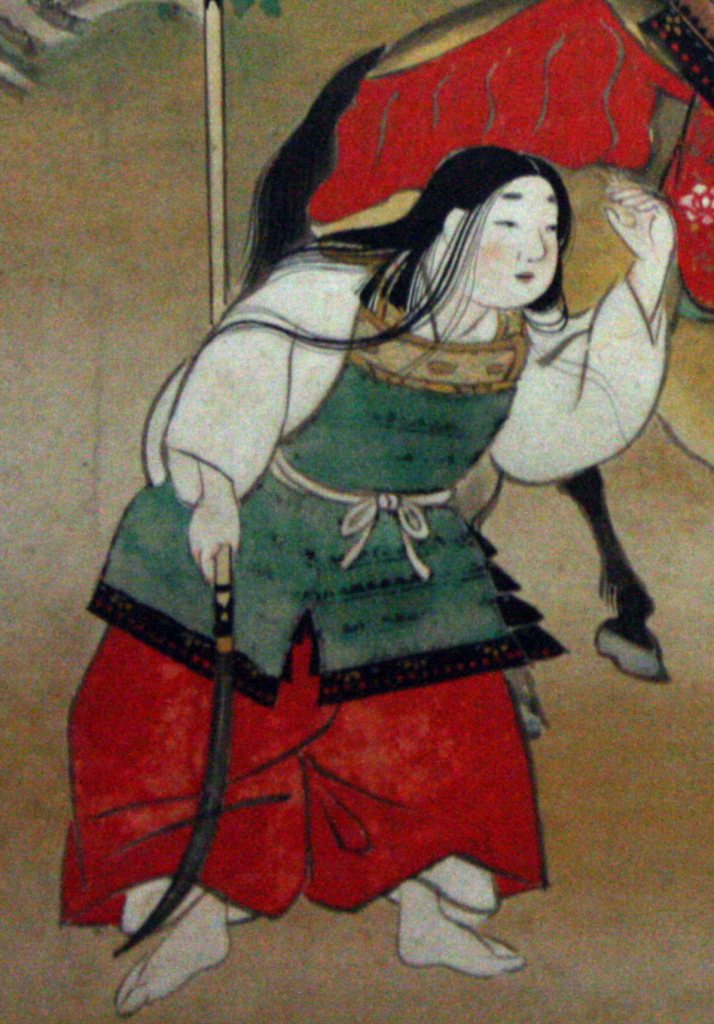
Image from Illustrated Story of Night Attack on Yoshitsune’s Residence At Horikawa, 1550.
 |  |
| Katsura-obi used to hold wigs in Noh theater. The ends typically have more decoration than the portion where the knot is located. Image from Fukushokushi Zue. | Kake-obi tied in katawana musubi, Kamakura period. Kake-obi are always red due to ritual symbolism, and are used for pilgrimages. Her hoso-obi is not visible, but is likely solid color. Image from Kasuga Gongen Kenki. |
Construction:
The books we have detailing sewing patterns based on extant garments do not include obi. It is a safe assumption that there were multiple construction techniques used based on the stiffness of the fabric used relative to the desired final stiffness of the obi, as well as social class and the function of the obi in question. Items with similar construction, such as hakama ties, can give us an idea of methods (for example, in Japanese sewing methods you do not clip the corners when turning tubes inside out!). These methods originally used hand slip-stitching, and would need to be adapted if you wanted to use a sewing machine.
This is a video of the reconstruction of a Nara-period obi using a silk core.
 |  |
| This hakama tie diagram from Shiryō Nihon Ifuku Saihōshi shows a simple tube with edges staggered to reduce bulk, and a paper stiffener only in the body portion. | This hakama tie diagram from Jidai Ishō no Nuikata shows the fabric folded in half twice, essentially serving as its own stiffening core. |
 |  |
| One possible construction for a modern obi with a separate core – for more, check out https://www.kimonoya-japan.net/page/38 | A modern kimono collar showing how the seam allowance is sewn down before turning it right side out (note the lack of clipped corners!), Hajimete no Wasai |

diagram by Morikawa Rei
Shōsōin Repository obi associated with Emperor Shōmu (聖武天皇), 701-756
Twined silk gauze (ra) #104 with sappanwood-dyed plain-weave thick silk (futo-ori) core, pointed end, and center seam, decorated with carved-board resist (kyōketsu), embroidery, and gold and silver painting, 4 x 260cm.
Images from Shōsōin website, https://shosoin.kunaicho.go.jp/en-US/


Flat braid Chest #84 Box #60, #1 and 2. Multicolored two-unit silk braid with fringed ends, 6 x 132.5 and 6 x 189.5cm.

| Width (cm) | Length (cm) | |
| Embroidered ra #109 | 4 | 146 (fragment?) |
| Embroidered ra #104 | 4 | 260 |
| Flat braid #104 | 4 | 260 |
| Flat braid #101 | 5.5 | 214 |
| Flat braid #5 | 6 | 212 |
| Flat braid Chest #84 Box #60, #1 | 6 | 132.5 |
| Flat braid Chest #84 Box #60, #2 | 6 | 189.5 |
| Flat braid #12 | 9.5 | 213 |
Men’s obi gifted by Tokugawa Ieyasu (徳川家康), 1543-1616
Images from Cultural Heritage Online, https://bunka.nii.ac.jp/
| Width (cm) | Length (cm) | |
| Short red silk rinzu uwa-obi | 2.5 | 140.0 (goes around once) |
| Long red silk rinzu uwa-obi | 2.5 | 246.0 (twice) |
| Brown silk twill hoso-obi | 3.0 | 256.0 (twice) |
| Narrow white hemp uwa-obi | 5.5 | 98.0 (once) |
| Indigo hemp uwa-obi | 6.0 | 368.0 (three times) |
| Wide white hemp uwa-obi | 11.0 | 347.0 (three times) |
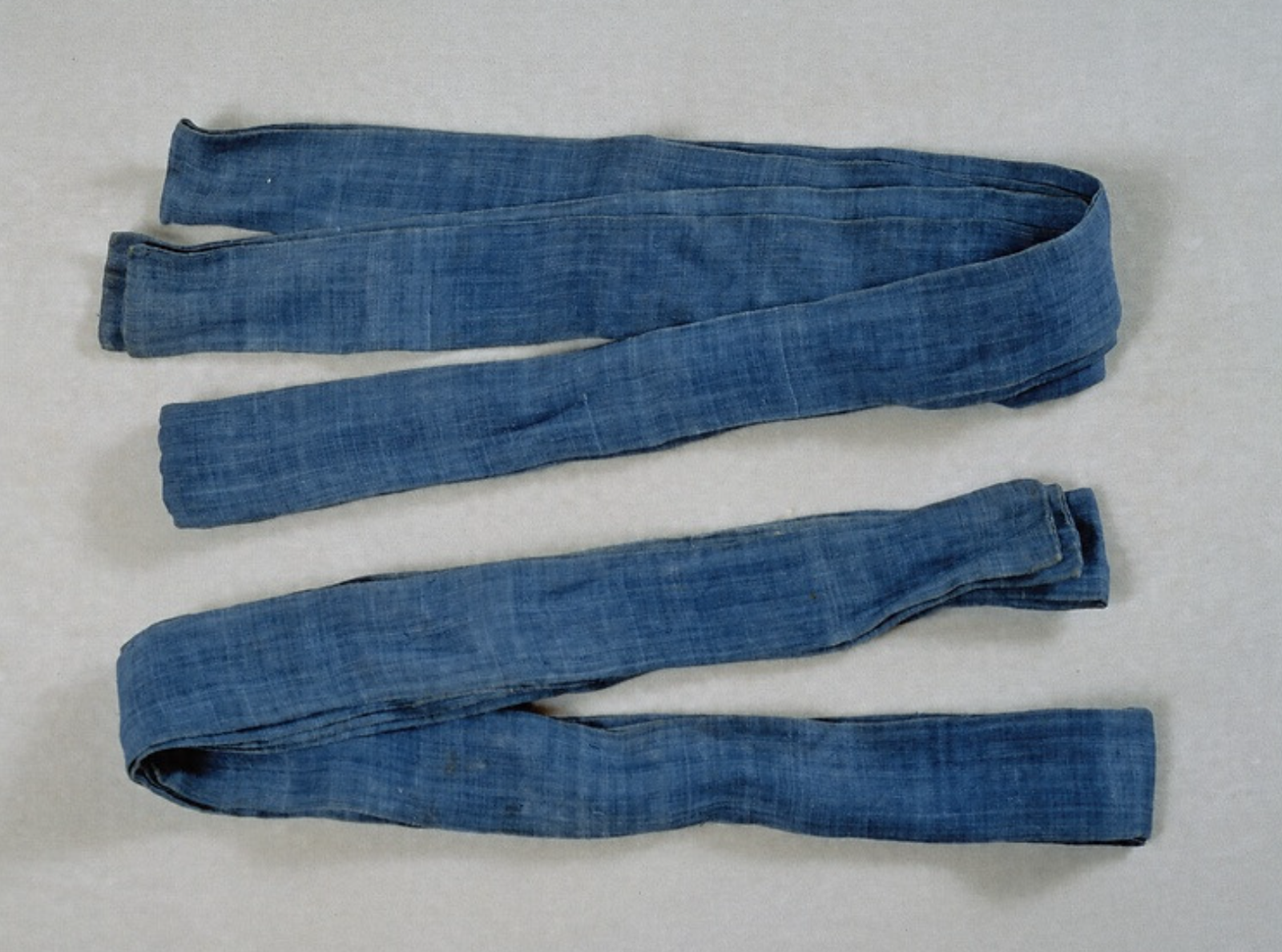

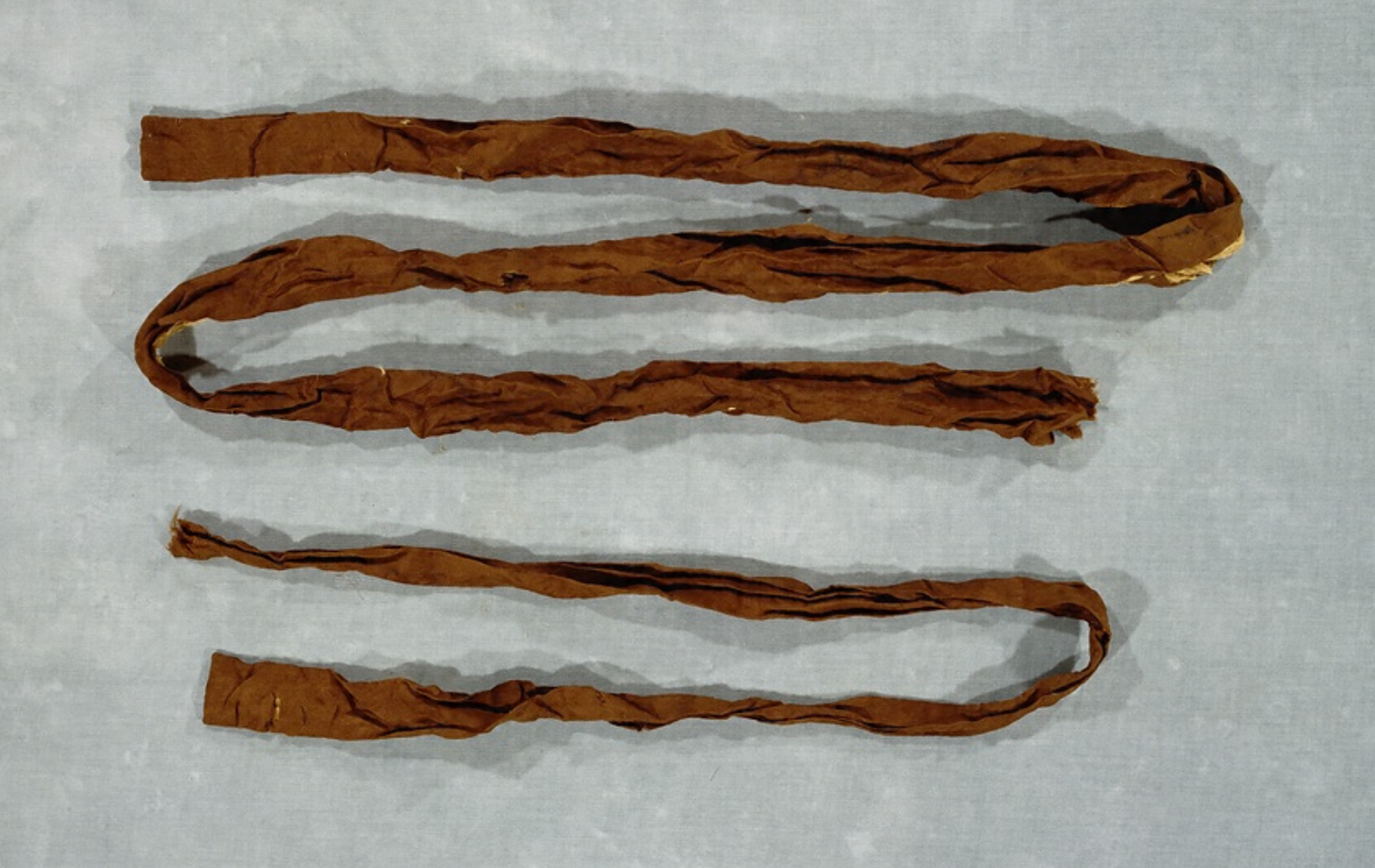
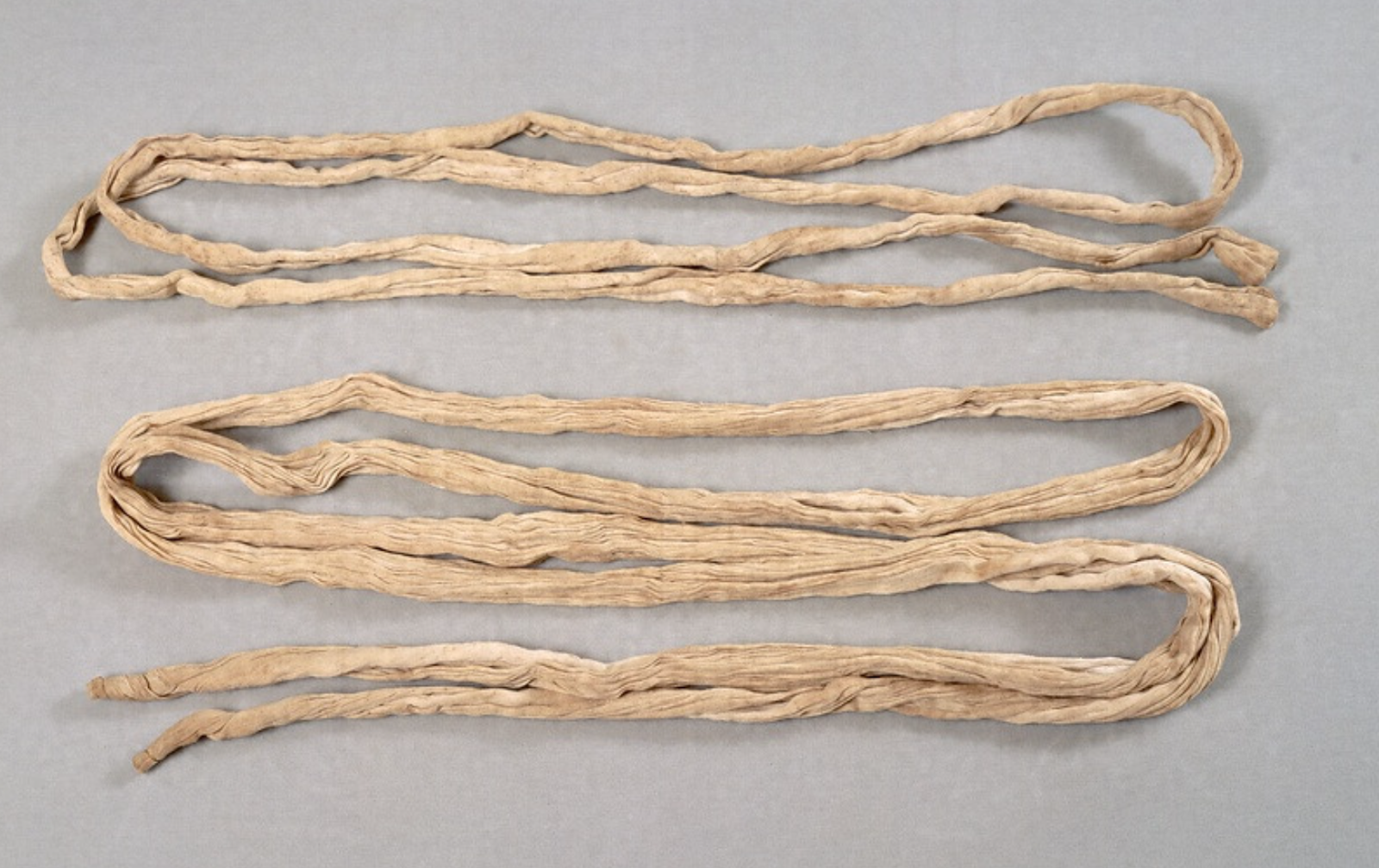
Obi belonging to Misawa Hatsuko (三沢初子), 1640-1686
(note: as obi from the late 1600s, these are on average wider than obi from the 1500s, but they’re the oldest women’s obi we have aside from ones in the Shōsōin.)
Cultural Heritage Online https://bunka.nii.ac.jp/heritages/detail/132454
Sendai City Museum https://jmapps.ne.jp/scm/index.html
Image from Nihon no Bijutsu #67
| Width (cm) | Length (cm) | |
| Light blue and red-dyed omi-obi on pine, bamboo, and plum-patterned rinzu silk | 5.5 | 109.0 (undergarment layer, only goes around once) |
| White rinzu silk obi with blue and black cloud-shaped rice-field pattern | 8.0 | 212.0 |
| Dark brown obi with snowflake butterfly arabesque in diagonal stripes | 8.4 | 284.0 |
| Black and gold satin brocade obi with three-leaf hollyhock, arabesques and chrysanthemum | 8.7 | 264.5 |
| Light blue satin obi with bellflower pattern | 9.2 | 294.0 |
| Red brocade obi with alternating good fortune pattern | 10.5 | 298.5 |
| White obi with brown warped octagonal pattern | 11.5 | 284.5 |
| Striped satin obi with flower and bird design | 11.5 | 272.5 |
| White satin obi with bellflower pattern | 12.2 | 274.0 |
| White rinzu silk obi with snowflakes and spring flower pattern | 13.0 | 280.5 |
| Black rinzu silk obi with snowflakes and plum tree pattern | 13.0 | 272.5 |
| Light blue rinzu silk obi with framed plum pattern | 13.0 | 277.0 |

References:
- Horikoshi, Sumi. Shiryō Nihon Ifuku Saihōshi. Yūzankaku Shuppan, Tōkyō, 1974.
- Kurihara, Hiro and Machiko Kawamura. Jidai ishō no nuikata. Genryūsha, Tōkyō, 1984.
- Nihon Wasō Kyōiku Kyōkai hen. Jidai ishō no kitsuke: suikan kazami tsuboshōzoku uchikake sokutai jūnihitoe. Genryūsha, Tōkyō, 2007.
- Ōtsuka Sueko. Hajimete no Wasai. Seibidōshuppan, Tōkyō, 1993.
- Tōkyō Kokuritsu Hakubutsukan. Nihon no Bijutsu 67: Kosode. Shibundō, Tōkyō, 1966.
- Tōkyō Kokuritsu Hakubutsukan. Nihon no Bijutsu 514: Obi. Shibundō, Tōkyō, 1966.
 旦暮庁 TANBO-CHŌ


Leave a comment