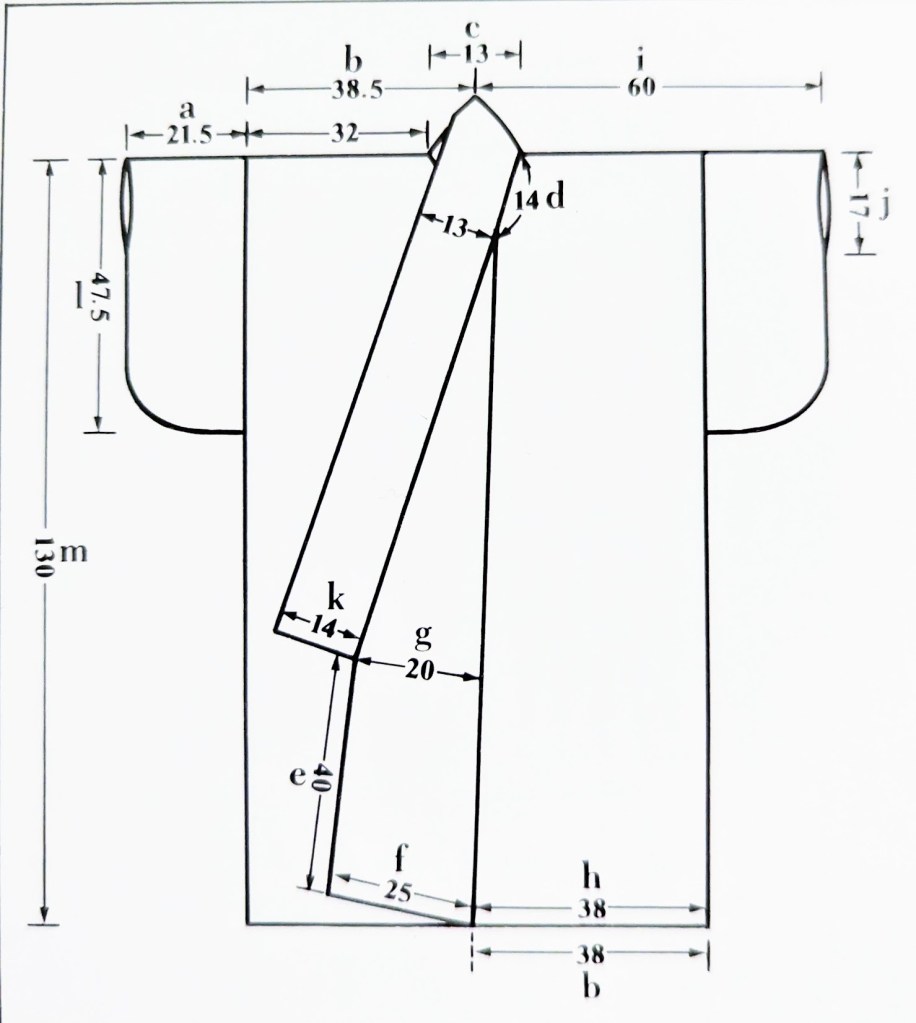
a: sode-haba (袖幅, ‘sleeve width’),
b: ushiro-haba (後幅, back width’)
c: erikata-aki (襟肩明き, ‘collar-shoulder gap’) x 2
d: okumi-sagari (袵下がり, ‘okumi drop’)
e: tate-zuma (立褄, ‘rise from hem’) also called eri-shita (衿下, ‘below collar’)
f: okumi-haba (袵幅, ‘okumi width’)
g: aizuma-haba (合褄幅, ‘joined hem width’)
h: mae-haba (前幅, ‘front width’)
i: yuki (裄)
j: sode-guchi (袖口, ‘wrist opening’)
k: eri-haba (襟幅, ‘collar width’)
l: sode-take (袖丈, ‘sleeve height’)
m: mi-take (身丈, ‘body height’)
Garment features:
- Eri (襟): collar
- Fuki (袘): the portion of the lining visible at the hem, not always present
- Furi (振り, ‘swing’): the sleeve side of the underarm opening, ie. the part of the sleeve that can swing because it is not attached to the body
- Gakubuchi (額縁, ‘picture frame’): mitered corner (angled intersection of two edges, as at the corner of an unlined okumi)
- Himo (紐): string or tie
- Hōeki (縫腋, ‘sewn armpit’): garment sewn fully closed under the arm
- Ketteki (闕腋 or 欠掖, ‘lacking armpit’): garment with underarm holes (wakiake)
- Kyaku (脚): leg
- Machi (襠 or 裆): gusset
- Mata (胯): crotch
- Migoro (身頃, ‘body section’): the main body panel
- Miyatsuguchi (身八つ口, ‘body’s eighth opening’): body side of the underarm hole (the ‘eight openings’ are the neck, hem, cuffs, body sides of the underarm hole and sleeve side of the underarm hole)
- Momodachi (股立, ‘thigh rise’): hakama side vents
- Okumi (袵): front gore between collar and body panel
- Sode (袖): sleeve
- Suso (裾): bottom portion, area near the hem
- Tsuma (褄): hem
- Wakiake (脇明け, ‘armpit opening’): open underarm hole
Hand sewing:
- Unshin (運針): fast running stitch method, can sew a meter in 3 minutes
- Nuime (縫い目): stitch; stitch length
- Nuishiro (縫い代): seam allowance
- Yotsu-nui (四つ縫い): sewing four layers of fabric together with a single line of stitching (normally two layers of exterior fabric right sides together and two layers of lining fabric right sides together).
- Kise (被せ, ‘cover’): a tiny (~2mm) fold which hides the stitching at a seam
- Kenuki-awase (毛抜き合わせ, ‘tweezer join’): hiding a slipstitch by placing it ~2mm inside two folded edges (see hon-guke)
- Yubinuki (指貫): thimble, especially a ring thimble
Running stitches
- Nami-nui (並縫い, ‘ordinary stitch’): standard running stitch (3-4mm stitch length)
- Gushi-nui (ぐし縫い): fine running stitch (2mm stitch length)
- Nido-nui (二度縫い, ‘double stitch’): two parallel running stitches – the first creates the seam, the second holds the seam allowances together, often used for the center back seam
- Shitsuke (仕付け, ‘discipline’): basting
Slip stitches
- Kuke (絎, ‘blindstitch’): a blindstitch/invisible stitch
- Hon-guke (本絎, ‘true kuke’): slipstitch that joins two edges folded toward each other, such as the edge of a lined collar
- Mimi-guke (耳絎, “ear kuke’): running stitch with a particular short-short-long pattern used to quickly tack down seam allowances
Reinforcement stitches
- Nui hajime no itodama (縫いはじめの板玉, ‘sewing start thread ball’): wrapping the thread around your finger and rolling it off to create a beginning knot
- Kaeshi-bari (返し針, ‘return needle’): backstitch; a single backstitch is placed at the beginning and end of every seam
- Tama-dome (玉止め, ‘ball stop’): winding the thread around the needle before making the last stitch to create a finishing knot
- Kannuki-dome (閂止め, ‘bar stop’): reinforcement stitch used to strengthen high-stress locations
Primary sleeve categories
- Kosode (小袖): small sleeve opening; uchikake, shitagi, aigi, katabira are all types of kosode
- Ōsode (大袖): wide sleeve opening; hitoe, uwagi, uchiki, uchigi are all types of ōsode
Specific sleeve types

- Hirosode (広袖): 1.5 panel sleeves used for kariginu, suikan, etc.
- Hiresode (鰭袖, ‘fin sleeve’) outer half-panel section
- Okusode (奥袖, ‘deep sleeve’) inner full-panel section
- Koiguchisode (鯉口袖, ‘carp-mouth sleeve’): tapered
- Makisode (巻袖, ‘wrapped sleeve’) triangular, used for undergarments, working attire
- Nagasode (長袖, ‘long sleeve’) sleeve with a long furi used on children’s garments
- Tsutsusode (筒袖, ‘tube sleeve’): straight, narrow, utilitarian sleeve used for undergarments, working attire, some fighting attire
- Funazokosode (舟底袖, ‘boat-bottom sleeve’): continuous curve shaped like the bottom of a boat
Sewing instructions
- Ato (後): back, rear
- Haba (幅): width
- Hyōri (表裏): front and back, both sides
- Jun ni (順に): in order, one by one
- Mae (前): front
- Mimi (耳): selvedge
- Musubu (結ぶ): to tie or knot
- Naka-omote (中表): right sides together
- Nuno (布): fabric, piece of fabric
- Nuu (縫): to sew
- Okununo (奥布): inner piece of cloth
- Omote (表): exterior, face
- Oru (折る): to fold
- Shirushi (標): a guide mark
- Shiyōhō (使用法): instructions
- Soto-omote (外表): wrong sides together
- Tachime (裁ち目): cut edge (not the selvedge)
- Tatsu (裁): to cut (cloth)
- Todomeru (留める): to attach, stop, keep in place
- Tsukau (使): to use
- Tsuzuku (続): to continue or follow
- Ura (裏): interior, reverse
- Yō (用): use or purpose
- Yosumi (四隅): 4 corners, 4 ordinal directions
References:
- Bunka Fashion Research Institute, Joint Research Center for Fashion and Clothing Culture. “The education program for the cultural folklore and for the transmission of “Kimono” culture.” https://kimono-bunka.ynu.ac.jp/nuikata_en/01/02.html Accessed 4/10/24.
- Nishimura, Fumiko. Wasai Seigi. Sōeisha, Tōkyō, 2000.
- Ōtsuka, Sueko. Hajimete no Wasai. Seibidōshuppan, Tōkyō, 1993.
- Shōgakukan. Encyclopedia Nipponica, 2nd edition. Shōgakukan, Tōkyō, 2001.
 旦暮庁 TANBO-CHŌ
Leave a comment