We begin to see illustrations of wearing a garment draped over the head in the Heian period, and the style remained popular well into the pre-modern era.
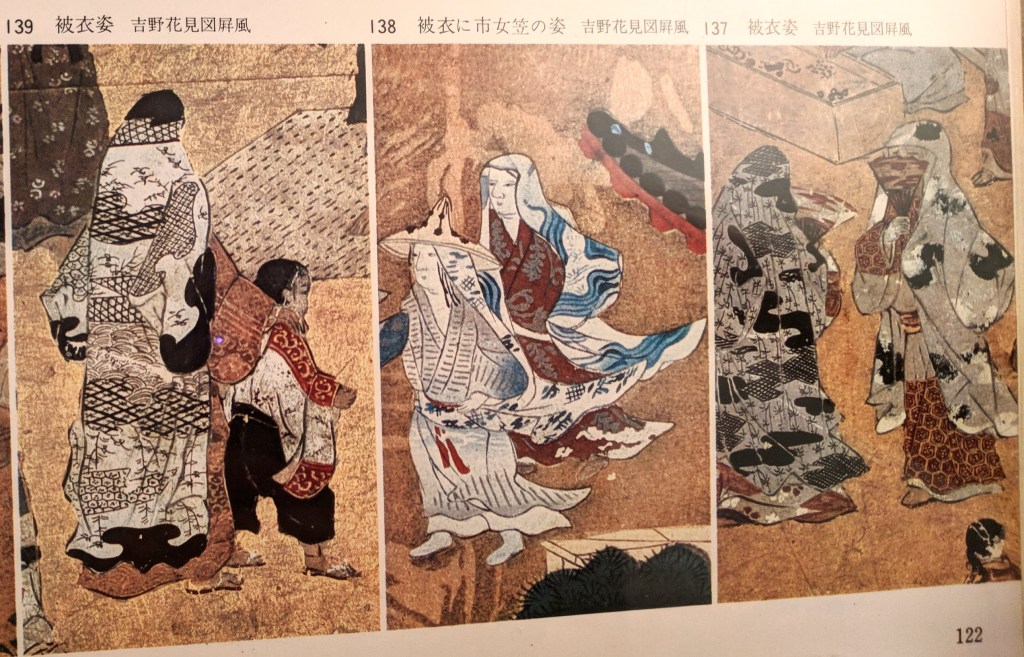
Note that a hat can be worn on top of the head drape!
Terms:
- Ōsode (大袖) – garment with wide sleeve openings (lit. “big sleeve”). A common outer layer particularly during the Heian and Kamakura periods.
- Uchiki (袿) – type of ōsode
- Uchiki o tsubōru (袿を壺折る) – wearing an uchiki over the head as part of the tsubo-shōzoku (women’s traveling ensemble)
- Kosode (小袖) – garment with small sleeve openings (lit. “small sleeve”). The most common basic garment throughout early Japanese history.
- Kosode o kazuku (小袖を被く) – wearing a kosode over the head. Also pronounced katsugu.
- Kazuki (被衣) – a garment (either an ōsode as in the picture below or a kosode) specifically designed to be worn over the head by setting the neck slit forward relative to its usual location at the shoulder peak. A standard kosode can be used for kazuku, but a kazuki can’t be worn as a standard kosode. Also pronounced katsugi.

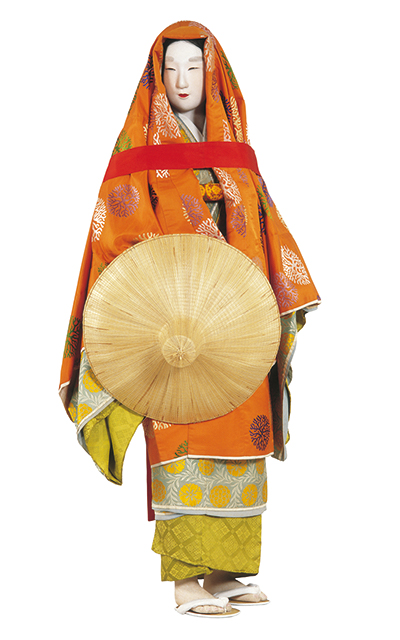
The red kake-obi around the chest marks her as being on a religious pilgrimage
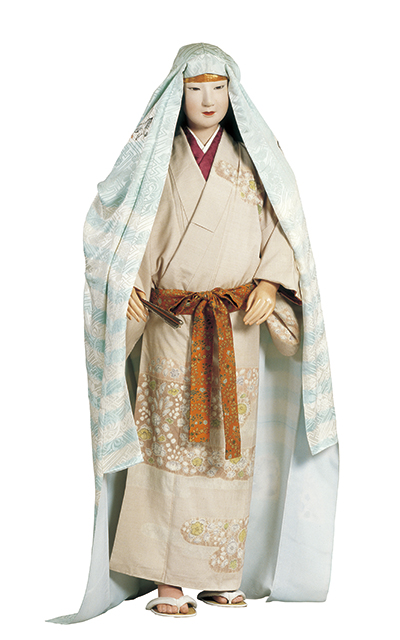
Orange katsura-obi around head helps prevent sliding
In order to make the drape more secure, fabric ties called katsura-obi (鬘帯) could be tied around the head to serve as a secure base. Their use dates back to at least the Kamakura period and continues today in Noh theater. They are approximately two inches wide and often made of embroidered silk (for the theater and upper classes, at least). The embroidery is often focused on the center and ends, as these are the most visible locations, and you wouldn’t want the part used to tie the bow to be stiffened with embroidery.
If you do an image search for the characters 鬘帯, you’ll find mostly costuming used in Noh theater, but the patterns used typically date back to the Momoyama period or earlier.
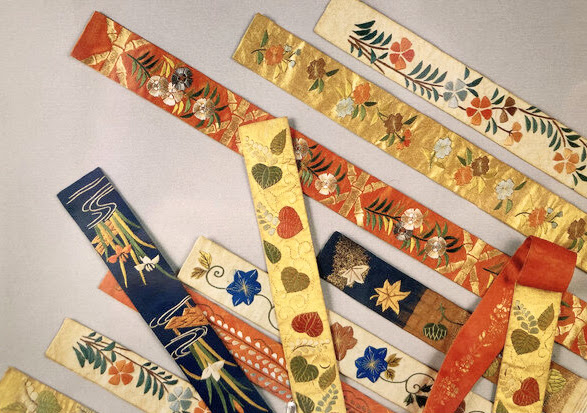
Photo series of how to tie a katsura obi by Atsushi Yoshida, Noh performer.
Recreating the look
Step 1: The base and katsura-obi
The Noh performer linked above wears a closely-fitted black cap as a base layer, preventing oil from the skin and hair from dirtying the obi and kazuki. We can only speculate about earlier base layers, but they may have simply been a piece of fabric tied around the head. In this image, I’m wearing a square of white ramie fabric secured only by the katsura–obi. If you’re wearing this frequently, you might want to sew ties on the base layer.
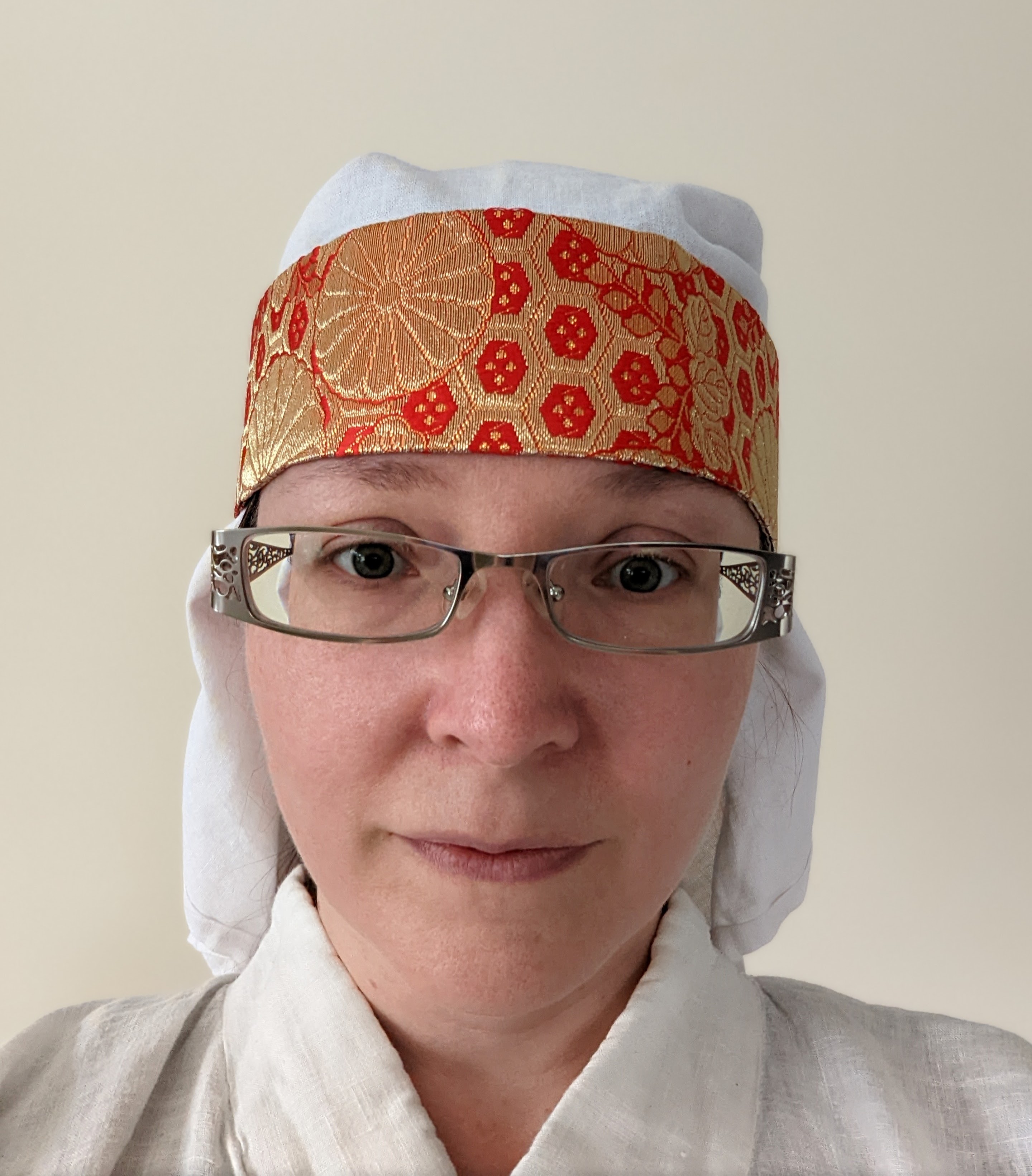
The katsura-obi can then be tied on as in the photo series above. The following is my personal hypothesis for how the kazuki could have been firmly secured.
First, you MUST be using a garment with a wide collar (hiro-eri, not bō-eri or bachi-eri). That means that the collar is 5-6 inches wide, and is folded in half for wear.
In these images, I’m using a navy blue hachimaki with a white arabesque (karakusa) pattern to secure the kazuki, but any fabric tie about two inches wide and long enough to be tied around the head will work.
With the collar unfolded, place the tie as shown.
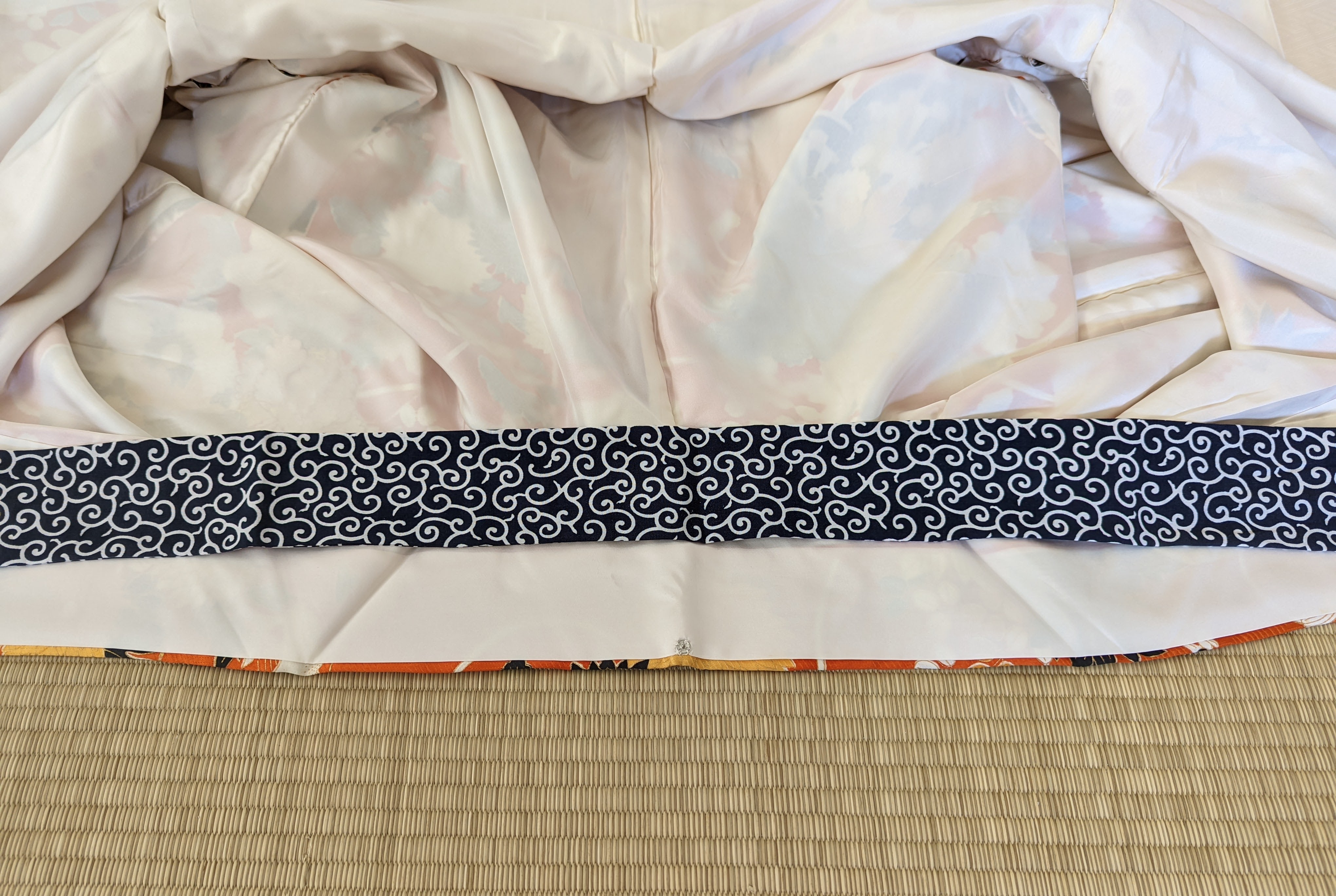
Fold the collar closed over the tie. If there is a way to hold the collar closed, such as a thread “drawstring” or a modern snap, fasten it.
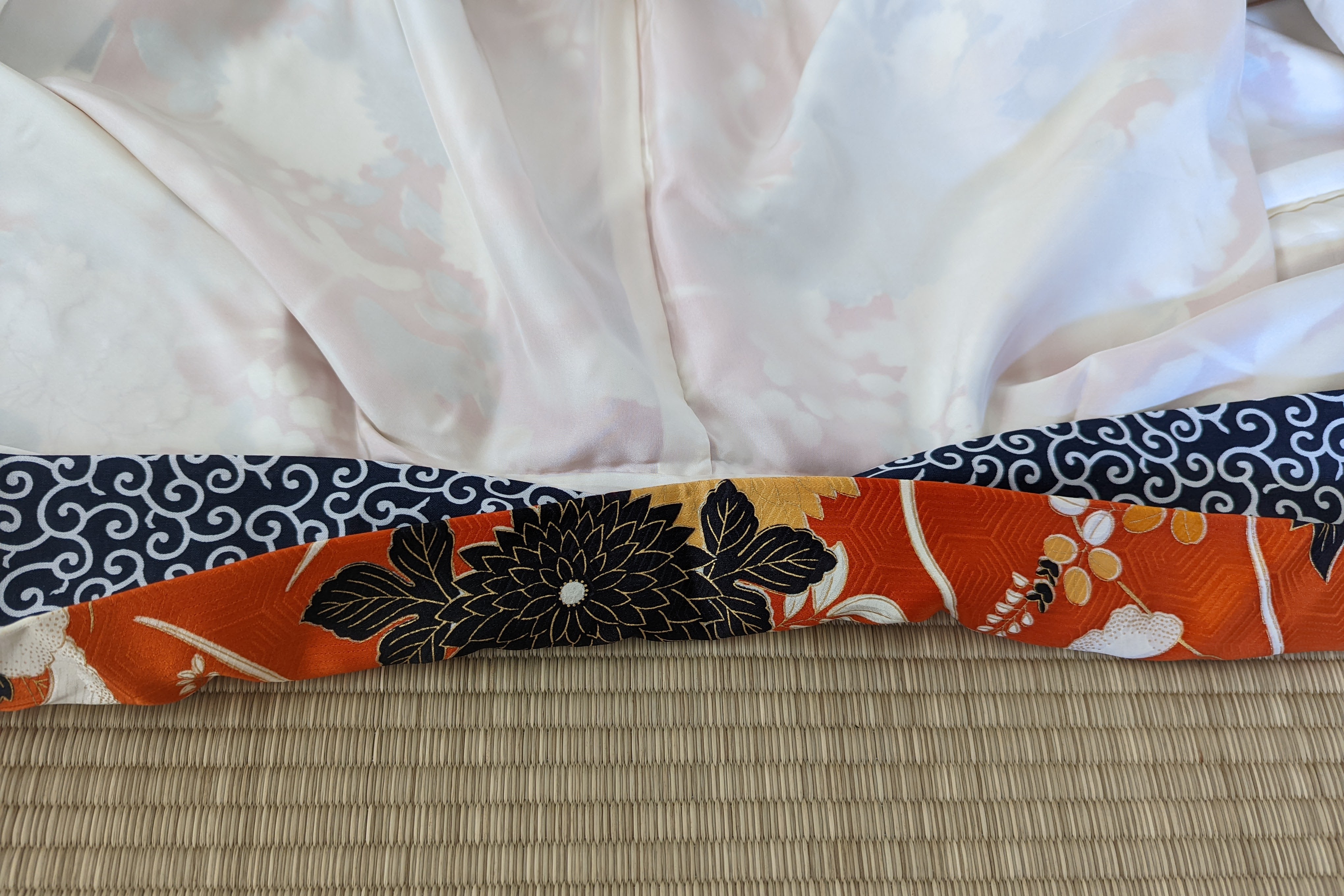
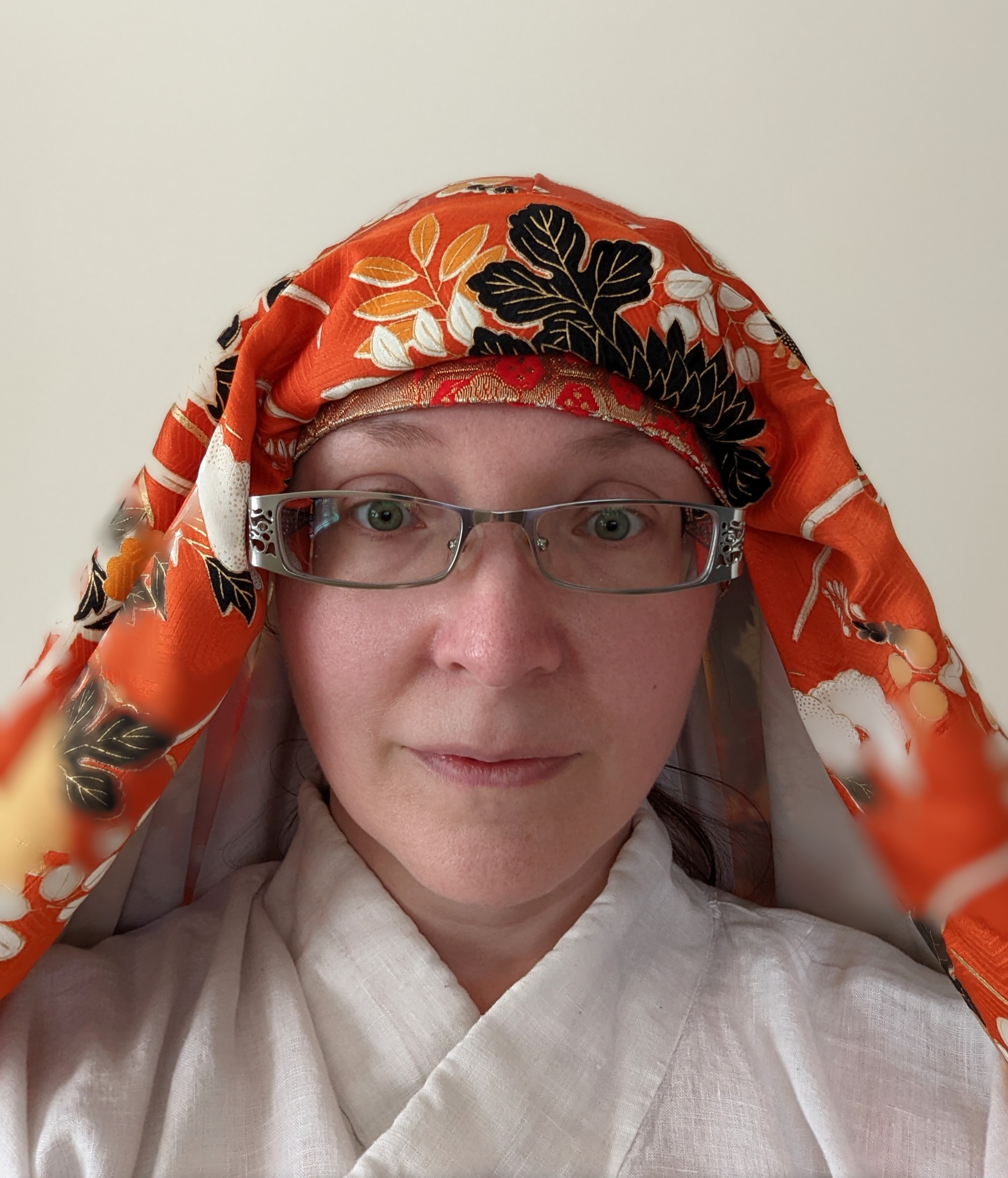
Holding the collar with both thumbs on top, swing it behind you as if putting on a coat and place the collar on your forehead. Hold the collar to your forehead with one hand as the other pulls the ends of the tie tight at the back of the head. Once the ends are held tightly, you can let go of the collar and use both hands to tie at the back. It helps to place most of the weight of the garment on a nearby table as you do this.
If you have trouble with this, it may help to pre-tie. You can then hold the collar in place on the forehead with one hand and pull the knot down over the back of your head with the other.

I find that this method of tying holds the kazuki securely for long-term wear, even when it’s heavy.
References:
- “The Costume Museum – The Rebirth of the Tale of Genji.” https://www.iz2.or.jp/english/ Accessed 4/2/22.
- Cultural Digital Library, “Noh”. https://www2.ntj.jac.go.jp/dglib/contents/learn/edc9/kouzou/mask_custome/custome/idetachi_women.html#kazuraobi Accessed 4/2/22.
- Sawada, Kazuto. “被衣.” Rekihaku #127. https://www.rekihaku.ac.jp/outline/publication/rekihaku/127/witness.html Accessed 2/29/24.
- Suzuki, Keizo. 有識故実大辞典 / Yūsoku kojitsu daijiten. Tōkyō: 吉川弘文館. 1996.
- Yoshida, Atsushi. https://hananoh.kyo2.jp/e20788.html Accessed 4/2/22.
 旦暮庁 TANBO-CHŌ
Leave a comment