This article is the first in a series of articles about katazome. The series begins begins with a historical overview of early katazome dyeing. The rest of the internet covers katazome in the later Edo and Meiji periods extremely thoroughly. Following this article, I will have a technical overview of the process, and then I will discuss each part of the ten step process in a separate article. It will be a long endeavor, and probably take me about a year to write it in full, so please be patient as I give each topic the attention it deserves.
Introduction
Japanese katazome is a resist dyeing process that uses rice paste and katagami (persimmon tannin paper stencils) to create very fine quality patterns on fabric and paper. Similar technology developed in China using soybean resist, while Japanese resist dyeing relies on komon nuka. Komon nuka is defatted rice bran, which is a byproduct of rice oil production. It is the komon nuka, combined with the unique properties of kakishibu paper, that allow for the especially precise detail of Japanese stencil dyed fabrics. This precision allowed for a specific type of fabric pattern, edo komon, to flourish and develop, alongside delicate renderings of large patterns, chuugata.
This article examines the history and development of stencil dyeing in Japan up until the end of the Momoyama era. Stencil dyeing experienced a Renaissance in the Edo period that followed. Edo period stencils could (and have) filled a book in their own right. We shall limit our focus to the early development of stencil dyeing so that we can give the growth of the technology the proper attention it deserves. Muromachi and Momoyama period katazome is frequently overshadowed in history books by the surplus of fine examples from the Edo period. While they are very beautiful to examine, especially when there are so many well preserved extants, the earlier period stencils exhibit a freedom and character that is unique and uninhibited by later laws and attitudes.
For a brief understanding of the modern stencil dyeing process, as well as a really nice look at a traditional craftsman, please see these videos:
手技TEWAZA「琉球びんがた」RYUKYU-BINGATA (DYEING)/伝統工芸 青山スクエア Japan traditional crafts Aoyama Square.
Precursors to Stencil Dyeing
There were other forms of pattern dyeing that were used before stencil dyeing, and they played an important role in katazome’s technological development. Stencil dyeing did not appear out of nowhere; it arose from the desire to place durable patterns on fabric, and was the result of centuries of innovation and refinement of earlier techniques. Many of these techniques used before katazome had limitations that the later process resolved or at least improved.
In the Nara period, roukechi / 臈纈 (Japanese Batik) and kyoukechi / 夾纈 (board resist clamping) were the popular methods of dyeing cloth. In the Heian period, leather was dyed using the fumikomi (step-in) method, which involved pressing stencil paper into leather by stepping on it, and then applying dye directly (no resist).
Resist dyeing is associated with cheap mass production in the Edo period and later, but if you look at these examples from the Nara period, it becomes evident that resist dyeing was as material and labour intensive as the woven patterned textiles they were mimicking. Wood blocks had to be carved, beeswax had to be imported, and dye had to be applied individually to certain places.
Nara era and Heian era technologies did not produce the level of sophisticated, precise pattern that stencil dyeing did in later times. Roukechi tends to spread and crackle, and it must either be hand applied or use a carved wooden block to apply the wax. Kyoukechi requires two identical wooden boards to be carved, and because they must be structurally stable for a large amount of pressure during the clamping process, the patterns they can produce are more limited than paper carved patterns. Surizome is limited in that it can only add color, and must use something like gofun (chalk white) to lighten fabric. Its expression of shading is limited by the fact that the dye must be rubbed or printed on somewhat dry to prevent bleed. Woodblock printing is limited to what shapes can be carved, and the expression of different colors either has to be multi block printed or somehow applied to the block. Hand painting dye requires a very high degree of skill to achieve fine detail, and it is extremely laborious to paint an entire bolt; however it is puzzling why it was not more widely adopted among the nobility, considering their hunger for other, equally laborious textiles (tsujigahana and brocades). Fumikomi is naturally limited to leather because it requires the production of a raised surface to seal the dye from bleed.
Let’s examine each of the technologies in detail so we can understand the role each played in modern resist development.
Earliest Use of Stencils
In these extants, cut paper was laid over the paper before the paper was sprayed with paint (note the flecked pattern). It’s interesting to note this is the inverse of katazome. The earliest use of paper to make a pattern in Japan can be found in the Shosoin Repository, whose stores date back to the 8th century. The technique used is actually the inverse of stencil dyeing, where the paper itself is the resist. Paint is blown overtop the paper stencil to create a resisted pattern.

Shosoin Repository

Shosoin Repository
Earliest Use Of Resist Paste
The earliest use of resist paste (but not stencils) – it was likely hand drawn. The classic pattern breaks that would accompany such a complex paper stencil are absent. It is from the Todaiji repository, 8th Century. After the resist paste was applied, then the leather was dyed with smoked pine needles. What’s remarkable is the quality of the resist paste – note the extremely fine detail it captured.

8th Century
Todaiji Temple

8th Century
Todaiji Temple
You can view photos of the smoking process of leather, from Inden-Ya, who carries on stencil dyed and lacquered leather traditions. After the resist is applied, the leather is smoked.
夾纈・ Kyoukechi (Clamped Board Resist)

Nara Period
Shosoin Repository
Note that the white lines are all connected – this is necessary so that the clamped boards are contiguous and connected. In contrast, it’s highly technical and difficult to get all the white lines on a paper stencil fully connected, especially thin ones, as they tend to be delicate and are easily damaged during paste application. It’s more common for the lines to be slightly disconnected. Thicker, fully connected lines and the age of the piece are good ways to distinguish kyoukechi from katazome.
This technique required a very high level of skill, and it was eventually lost for a time. It can be seen today in modern “itajime” shibori, which sometimes uses clamped rectangles and shapes, but in a much less intricate form.
Here is a modern revival of the textile, you can see the process and tools used:
ろうけつ染め ・蝋染め・ Roukechizome ・ Wax Resist

Nara Period
Shosoin Repository
These screens were dyed using roukechi, which is the Japanese version of Batik. Wax was applied to create a resist pattern. It could be applied by hand, or with a carved wooden block. This technique was eventually lost until its later revival in the Meiji period, because the import of beeswax was stopped for unknown reasons.
Inspiration from Court Patterns
During the Heian Period, the court patterned fabrics were called Yuushou textiles, or “有職織物“.
They were made by weaving or embroidering the pattern into the fabric. The full variety can be seen here at the kyoto costume museum webpage.
二陪織物 Futae-Orimono (“double textile”)
This was the most common.
The next two extants are from the Asuka Shrine Treasures stored at the Kyoto National Museum. Because they are available at high resolution, they make good exemplars. They were handed down no later than the Muromachi period.

浮線綾 ・ Fusen Ryo (Floating Twill)

Notice for all of these, that the pattern stands off the body of the fiber and is vulnerable to rubbing and abrasion. It’s difficult to wear these textiles while being physically active and engaging in martial activities. One hypothesis is that ban-e, suri-e and katazome were developed to have a durable way of placing these patterns on fabric. It’s supported by the fact that most of the available early extants are on hemp, plain silk, or leather, and in garments designed for martial activities or other events where textured silk would be unsuitable, like bathrobes. However, it’s difficult to prove because we don’t have a significant sample size of extants to definitively draw the conclusion.
Take a look at the wear on this military jacket with karaori weaving, from the Azuchi-Momoyama period. Obviously, at 400 years old, it’s going to be a bit worn, but the point is to observe how the pattern itself wears first, and is not durable. In contrast, the much older stencil dyed gauntlets shown later have wear, but their pattern is preserved.

17th Century
蛮絵袍 ・Ban-e ・ Woodblock Printing
I believe 蛮絵袍 / Ban – e actually refers to the type of robe this sort of printing appeared on as well as this specific incarnation of woodblock printing. 木版染め (mokuhanzome) is a more generic way to express woodblock dyeing, but almost nobody use the term except one lonely studio in Kyoto.

Muromachi Period (1454)
Tokyo National Museum

Muromachi Period (1454)
Tokyo National Museum

Nara Period (752)
Shosoin Repository
This sock has been stamped with a Hanko, or signature stamp. This is technically a form of woodblock printing, or perhaps even metal or stone printing, depending on what the stamp was carved from. A unique and early extant.

Nara Period, 8th Century
Tokyo National Museum

Nara Period, 8th Century
Tokyo National Museum
Notice how the dye rests on top of the fabric, but does not penetrate to the other side. In stencil dyeing with resist, you would see more even penetration with the fabric. This shows that this design was rubbed or printed on.

My amateur guess at the layout. The birds are supposed to be facing each other.
摺染・ Surizome ・ Rubbing – Printing
Surizome is a little tricky because it refers to “rubbing” and “printing”, but it’s also used in cases where woodblocks were likely used in museums sometimes, which is confusing. Please look at each extant to understand where each term is used. Senshoku Bunka also has a helpful page.

Tokyo National Museum
Whole Picture Scroll Source
The roundels on the white garment could have been stencil dyed or rubbed on with soymilk binder and indigo through a stencil. Or, a mineral pigment could have been used, but I am not aware of how common that was. Because there is slight blurring, rubbing or flecking would match this illustration more accurately.

Tokyo National Museum
Whole Picture Scroll Source

Tokyo National Museum
Whole Picture Scroll Source
Both the triangles pattern here and the wheel pattern are good candidates for woodblock printing, although they could have been done with stencils. Simple, irregularly repeating patterns with sharp edges that are darker than their foreground are all hints that a pattern might have been block printed or used a stencil.
If the pattern is highly irregular and does not repeat vertically in a regular way, a woodblock was probably used. However, with scrolls it is sometimes difficult to tell.
This shirt could have been constructed with many techniques, but because the color is blue, either indigo pigment was rubbed on with soymilk, shibori was used, or it was stencil resisted.

Imperial Household Agency
1293
Originals in Full


Imperial Household Agency
1293
Originals in Full

It is tough to say if the original really was blue or black, but it changes the likely method of dyeing a little. However, surizome can be used to accomplish both blue and black patterns.
描絵 ・Kakie ・ Drawing or Painting
Direct painting was another method of applying patterns. It’s tough to control the spread of dye when you paint by hand, so it becomes difficult to apply precise patterns by hand, but it does make very beautiful, expressive work. Highly skilled painters eventually became very adept at painting crests at high precision, and it was sometimes used in conjunction with stencil dyeing for the focal pattern. Here’s a video of a modern craftsman: 東京 和のたくみ 紋章上絵師 波戸場承龍さん・耀次さん.
For this extant, the lines are certainly hand painted, but the flower and vines might be stamped.

8th Century
Tokyo National Museum

Tokyo National Museum
Whole Picture Scroll Source

Tokyo National Museum
Whole Picture Scroll Source
Both of these patterns, with their thin ink-like lines on white, might be kakie.

Momoyama Period, 16th Century
Uesegi Jinjya Shrine

Momoyama Period, 16th Century
Uesegi Jinjya Shrine
Here is a fabulous hand painted dobuku. I have a sneaking suspicion that this was dyed with mineral pigments, but I can’t find any information on this garment, unfortunately. The vibrancy of the colors despite the age, coupled with the delicacy of the hand painting, makes me suspicious. I’ve also read, in some of my practical stencil dyeing books, that mineral pigments are more forgiving with bleed and easier to blend. They’re also what’s used for painting on paper by traditional Japanese artists. This jacket contains very sophisticated blending, so I humbly submit my hypothesis that it was dyed with mineral pigments. If you want to see the full variety of classical mineral pigments available in Japan today, many of which are traditional, you can go to Kissho, one of the last suppliers.
暈し染・ Bokashizome ・ Ombre Dyeing
Bokashi is a form of dye application where an ombre effect is achieved by rubbing a dye brush repeatedly in parts of the fabric to make a gradient. Later on, bokashi dyeing would be used inside of resist paste areas, for shading areas such as petals and leaves.
海松丸文様小袖 ・Sea Pine Circle Patterned Kosode
Kyoto Dyer’s and Weaver’s Association Reproduction
童子水干姿 ・Heian Era Youth in Suikan
Kyoto Costume Museum
More info on bokashi at Kyoto Dyer’s and Weaver’s Association
踏込型 ・ Fumikomi and Stencil Dyed Armor
踏込型 (fumikomi), which translates to something like “stepping in”. The pattern paper would be stamped in by stepping on it to press it into the leather, and then dye would be applied. Gradually the technique was refined through the Heian period. This is how stencil paper was refined and developed. The designs began to be used with resist paste in the 1500s.
Fumikomi process video: 加藤鞆美 絵革作り|加藤鞆美 絵革作り
模造 逆沢瀉威鎧雛形 ・ Miniature Stencil Dyed Armor / Heian Period
Please click on the link above to see images of this armor. This is a miniature armor, and above on top is the original extant, and then the reconstructed version. The original dates from the Heian period and there is a longer discussion about it on the bunka website.
The stencil dyeing on the breastplate mimics the woven silk patterns of clothing worn in court at that time.
Here is another breastplate with a more delicate pattern from the same period. Please click on its link to see it in color.

Oyamazumi Shrine
Heian Period
Image Source
摺箔 ・ Surihaku
Surihaku is the technique of applying gold leaf to a garment with a paste that is stenciled on. It is hypothesized that the stencil dyeing paper later used for katazome may have originated with surihaku.
Unfortunately most modern artists have switched to mylar stencils or screen printing frames, so it’s difficult to show the traditional paper in use. However, you can get a great idea of the full process with this video: 桃山時代小袖 復元作業工程⑥(金彩) (youtube.com).

Momoyama Period, 16th Century
Tokyo National Museum

Momoyama Period, 16th Century
Tokyo National Museum
Here is a detail from a later robe that uses the same technique, where you can clearly see the repeat of the stencil on a small scale.

18-19th century
Tachibana Museum
絞り・Shibori
This is a topic much better covered by the expert, Oribe Tsukime, here: History of Shibori.
Shibori is a form of tie-dye, shibori literally means ‘to squeeze’. It resists through the clamping of cloth through stitches or boards (it overlaps with the clamped board resist in some ways).
For a long time, shibori was a very popular way to make resist, especially because the only special equipment required is thread and a way to pull it very tight. The resisted areas can be capped off with bamboo sheathing, which are freely available anywhere bamboo grows. Even a peasant could shibori dye their clothes, though it was the signature of the glamorous and coveted Momoyama tsujigahana dyeing. It welcomed all classes.
It’s important to understand the difference between shibori and paste resist. Both can make unique patterns that are more difficult in the other medium, though in modern times stencils are used to mimic kanoko shibori. Especially when examining extant scrolls for evidence, understanding shibori helps you to correctly identify stencil patterns. It’s also charming to combine them.
This pattern below could be stencil dyed, but it would look a little different. Take a look at the wrinkles, stitch marks, and charming organic edges to the lines. These are the hallmarks of shibori dyeing. It was so prized and beloved they left the wrinkles in, in part to show that it was not simply stencil dyed.

16th-17th Century
The Tokugawa Art Museum
As an example of shibori in scrolls, take a look at this gentleman from the Mongolian Invasion Scrolls. Almost certainly boshi shibori, but if you weren’t aware of it, you might mistake it for stencils.

Tokyo National Museum
Whole Picture Scroll Source
筒描き・Tsutsugaki
This technique applies rice resist freehand to the cloth with bronze tubes and kakishibu paper (they look like cake decorating squeezies, only eco friendly), and then applies rice bran as an intermediate step. Once everything is set, the cloth is dipped in indigo, and then the resist is removed.
Tsutsugaki most commonly refers to resist on indigo cloth – this technique is also used in the later yuzen dyeing, a complex process which involves both stencil dyeing and freehand resist, along with gold leaf on occasion.

16th Century
Muromachi to Azuchi-Momoyama Period
Seki City Kasuga Shrine
This is the earliest surviving example of tsutsugaki on a garment.. It’s a Noh costume. Look at the delicate, fully connected lines of the leaves and stems. While the poem cards could be made with stencil dyeing, the disconnected leaves and stems fully connected would require an unstable stencil that breaks easily. At first, this type of design and pattern would be reserved for the nobility and their entertainers. Beautiful, freehand patterns like this would eventually be worn by commoners in the 17th century, when cotton growing and cotton indigo dyeing spread widely throughout Japan.
Here’s a color image at very poor resolution, try to see the delicate colors of the leaves.

16th Century
Muromachi to Azuchi-Momoyama Period
Seki City Kasuga Shrine
Medieval Stencil Dyeing
It’s hard to say when stencil dyeing began in earnest in Japan.
The earliest extant we have is from the Kamakura period, but we have surprisingly few extants for a very long time until the Muromachi and Momoyama periods. This doesn’t mean that stencil dyeing wasn’t wide in use at this time, because there aren’t many Kamakura extants in general. Once extants pop up again, they have a very sophisticated level of dyeing compared to the early examples, which suggests that there must have been some level of stencil dyeing occurring in the 200 year extant gap.
Two technologies are needed for katazome: the special persimmon smoked paper and the resist paste itself. The Chinese had their own rice resist paste and techniques that they developed, and how much cross-cultural exchange occurred in the development of each culture’s resist technology is not well documented or researched.
We know that some sort of resist paste was used on the grape arabesque pattern in the Shosoin, and we also have examples of it being used on armor in later period. What we don’t have clear documentation of is the special paper, or a clear picture of how it was developed for stencil dyeing. There are similar varieties of paper used in Fumikomi and Surihaku, but there isn’t a clear link of archeological evidence showing how these papers were transitioned for stencil dyeing.
It’s also difficult to discern from paintings at the time what technique a painted representation of textile is supposed to be using. I have included the ones that are quite obvious or interesting, but there are many more that are ambiguous.
Extants where I could not get a clear depiction of the pattern at all have been omitted unless they were of unique importance.
Earliest Examples of Katazome

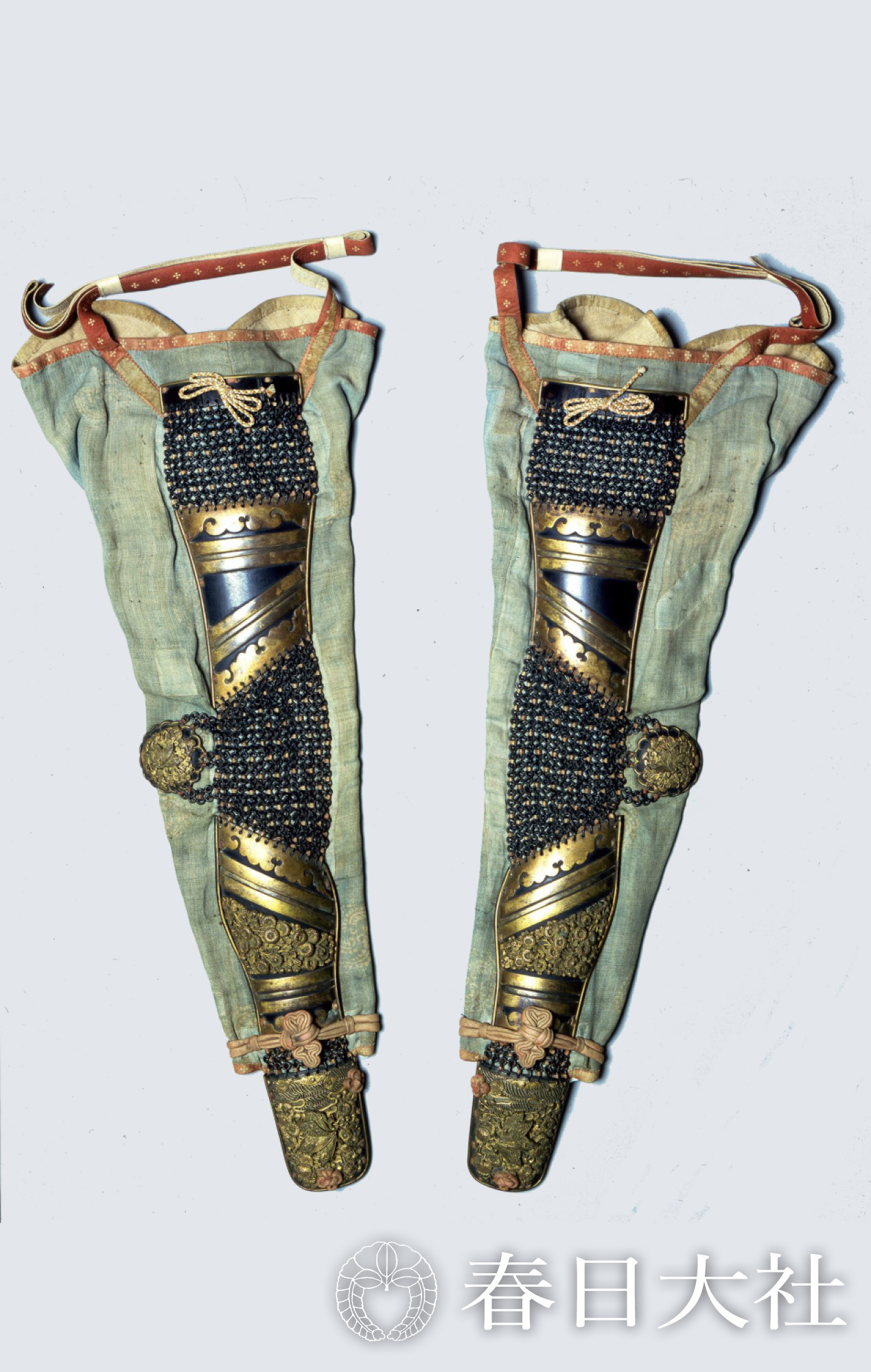
義経籠手 / Yoshitsune Gauntlet
Kamakura Period
Kasuga Shrine
So, unfortunately the public domain image of these gauntlets make it almost impossible to see the pattern, but if you go to the shrine webpage and look closely, you can see that the wisteria swirl pattern. This is the earliest known stencil dyeing on a textile. Note the large size compared to the other examples, and the comparatively imprecise lines.

1450s
Okinawa Prefectural Museum
For a long time I thought there were no RyuuKyuu (what is now modern day Okinawa) extants, but it turns out I just couldn’t find them. RyuuKyuu actually has a surviving robe from the 1450s along with some other garments. And they are extraordinary, with complicated dyeing processes and the use of a unique konjac paste. I am still working to understand how they were dyed exactly.
This is the best photograph I can locate. I also have a paper by a professor who visited the islands and drafted patterns, dyeing methods and pictures.

紅塔紙十四国赤本紙 / Beni-Cho Paper for Cosmetic Use
Kumano Hayatama Shrine
14th Century
This is cosmetic paper that was stencil dyed,, but because we have almost no extants for two centuries, it’s helpful in seeing the development of the technology.
Stencil Dyeing In Scrolls and Paintings
Because there are so few extants for the Kamakura period, illustrations offer the best idea of what stencil dyeing in period looked like. It’s difficult to tell what each one would be exactly, so each painting is annotated with possibilities. Tomoyuki Yamabe, a historical textile researcher, has examined these scrolls. He has asserted that a number of the white repeating patterns with a colored background (白抜きの文様), cannot be accomplished with shibori, and had to be accomplished with a stencil. He concludes that the resist must have been with rice paste, because the import of beeswax had been stopped at this time. and we have the example of the wisteria gauntlets to show that the technology did exist.
Based on Mr. Yamabe’s history, it seems he had direct access to the scrolls. I don’t, just digital copies. I’ve gone through them and will discuss possible stencil representation in them.

Tokyo National Museum
Whole Picture Scroll Source
The gentleman in green could be wearing a stencil dyed garment, because the pattern is regular and repeating all over. It’s difficult to tell if the background is yellow or white, but if it is yellow, the garment could have been dyed yellow, had resist applied, and then dipped in indigo to create green. It could also be surihaku (gold foil), though that seems like something that would not be great to wear horseback riding.
The gentleman in blue next to him on the left has a geometric white pattern on his indigo outfit. This is another good candidate for stencil dyeing, because perfectly regular geometric patterns are difficult to achieve with the other resist available at the time, which was shibori. The import of beeswax had already stopped at the time of this painting and had not yet been replaced with domestic production.

Tokyo National Museum
Whole Picture Scroll Source

Tokyo National Museum
Whole Picture Scroll Source
These patterns could have been accomplished with shibori or stencils.

Imperial Household Agency
1293
Originals in Full
Wikipedia (Japanese)

Reproduction
The original Mongolian Invasion picture scrolls are quite damaged and at poor resolution, so I creeped around the internet to find some restorations and high-resolution photos of the originals. Bamboo is a very good candidate for stencil dyeing because of its pointy, geometric pattern.

16th Century
Tokyo National Museum
The hakama are likely stencil dyed, at least in the green kelp and red wave parts. The black could be hand painted or stencil dyed. It’s also an interesting white background pattern which is not well represented in surviving garments from the Momoyama period.
Muromachi and Momoyama Period Extants

Muromachi Period (1568 or Earlier)
Uta City Museum

Muromachi Period (1568 or Earlier)
Uta City Museum
This dobuku (the ancestor of the modern haori) is stencil dyed softened leather in a pattern style called “komon”, which is the small repeating geometric pattern. In the Edo period, these patterns gained popularity and variety as stencil dyeing entered its renaissance.This is one of the oldest surviving examples of resisted komonzome.

Muromachi Period
Tokyo National Museum

Muromachi Period
Tokyo National Museum
This is an extraordinary outfit because it shows the use of bokashi (gradient painting) in period, as well as large patterns. Note that there is no resist separation between the black and the blue parts of the umbrella, and so the black would have to have been applied before or after the blue and blended with it.
Author Seiju Yamazaki explains how it was dyed, please excuse my poor japanese translating skills and paraphrasing. I’m still working to translate the names of two of the dyes:
The umbrellas were colored first with black and indigo, then 薄鼠 (usunezumi/ light lavender-grey) and 浅葱 (asagi /chive blue-green). Next, the umbrellas would be covered up with resist paste, and the ground color brown was dyed. Because the piece dates from the Muromachi period, it is likely that seeds were used. Judging from the existing colors, it seems that it was dyed using either 矢車附子 or 行橋, and a mordant of iron and lye was used.”
Seiju Yamazaki, 型染・引き染の基本 (草木染技法全書)

Uesegi Shrine
Momoyama Period

Uesegi Shrine
Momoyama Period
Reconstruction of what the stencil would have looked like. Author Seiju Yamazaki discusses this pattern in detail in his practical stencil dyeing book, and explains that it would have taken multiple passes of dye to achieve the stencil pattern. It shows how advanced stencil dyeing of the period was.

Katabira with small flower design
Worn by Usegi Kenshin
16th Century
Usegi Shrine
Close up of the kamon. The birds may have been painted on.

Katabira with small flower design
Worn by Usegi Kenshin
16th Century
Usegi Shrine

16c.
The Japan Folk Craft Museum, Tokyo
Although cropped, here is the textile in higher detail.

16c.
The Japan Folk Craft Museum, Tokyo
Momoyama To Early Edo Katazome
One of the difficulties with dating katazome prints is that they’re usually dated by the owner or the person who gifted them to the shrine where they were held. So we know that Tokugawa Ieyesu owned quite a few robes, but we’re not sure when he had a particular robe made … was it in 1605 (the Momoyama period) or 1615 (the Edo period)? Sometimes, there will be a note that the robe was gifted to someone on an exact date, and then dating is much easier, but that is lucky.
Even more troublesome, some of my older katazome books (and there are not really an embarrassment of katazome books out there, so I use what I can) will date garments earlier than current museums. If you are interested in exact dates, I encourage you to always check the links to the museum I have provided in the caption, if it’s available. The museum’s information will always represent the current research. However, Japanese museums date by era unless a specific date is available. On top of that, some scholars don’t consider the Azuchi-Momoyama period to be a true ‘era’, and so they will change the cutoff to either late Muromachi or early Edo. And there isn’t great agreement about when, exactly, all these eras end and start, either.
Because of all of this confusion, this section contains the examples that are more nebulous in terms of their dating, or firmly early Edo period. They are still representative of the techniques at the time – there’s no big stencil dyeing technical revolution occurring in say, 1615 that makes it radically different than what was being made in 1609. Additionally, many of them belong to Tokugawa Ieyasu, who, despite surviving into the Early Edo period, was much more a creature of the Muromachi and Momoyama periods (he died at age 73 in 1615). Take all of this into consideration as you examine the next set of examples.

Momoyama – Edo Period
Tokugawa Art Museum
This is the earliest “chuugata” pattern we have (larger size, not komon). It is thought the crabs were resisted on both sides, and then dip dyed in indigo. Putting resist on both sides is a fairly advanced technique (両面に防染糊を引く), and this is the first example we have of it. It became a hallmark of the chuugata (middle size pattern) technique. It makes the white and indigo contrast each other very crisply.
What’s also remarkable is how freely and irregularly the crabs are arranged. It’s playful and charming, and a contrast to the more regular arrangements of court robes or smaller patterns.
I made a reproduction of these stencils, and there are in fact only two distinct crab stencils, they are just very carefully arranged to look more unique.
A modern recreation that the Tokugawa Art Museum tweeted a while back, unfortunately twitter is a wasteland now and I can’t recover the original tweet.

Here is another chuugata pattern. Look at how elegantly it is aligned on the seams. It is made of ramie instead of hemp like the crab pattern.

Edo-Momoyama Period
Tokugawa Art Museum

Early Edo Period (1615 or Earlier)
Komon Dobuku

Early Edo Period (1615 or Earlier)
Komon Dobuku
The uneveness in the dye on this doboku is due to the fact that the pattern paper was folded and then cut to produce the stencil. Stencil cutters tend to work from pre-drawn patterns that they then trace onto the stencil and then cut. In this instance, the dobuku was made of imported fabric that was too wide for the pattern, so the stencil paper was folded and then cut all at once while folded. The top layer of the paper has wider, bigger cuts than the bottom layer, so there is a gradient of pattern brightness as you descend across the weft to the last layer of the stencil.
Modern stencil paper is usually not durable enough for this sort of treatment, so the stencil paper of this era must have been a little different.


Although this under armour may be just out of period (it is early Edo period, worn by Tokugawa Ieyesu), it shows the level of refinement and sophistication that was available to stencil dyers. It uses a technique called Okake-gata where two patterns are carved and the stencil is dyed in layers.
The resist is placed on only one side, in contrast to the yukatas.

Momoyama To Edo Periods
Kishu Toshogu Shrine


17th Century
Tokugawa Art Museum

17th Century
Tokugawa Art Museum
Unlike the crab yukata, this kataginu uses a one-sided dyeing technique.
Illustrations of Stencil Dyeing Process
Here is a surviving painting from the early edo period that depicts Momoyama Era stencil dyers. It is part of a larger ‘craftsman at work’ series of screens, all painted by the famous Kano Yoshinobu. It is a highly detailed work, and a lot can be learned from it. So much, that one research in Japan wrote an entire paper on it: 喜多院所蔵 職人尽絵屏風「型置師」に描かれた 染物・型付技法に関する一考察
One thing that’s interesting about this painting in particular is the number of white-ground prints that are hanging from his walls, as well as the mix of blue and reds. There are no surviving white ground extants, but they’re popular in modern Japan for summer wear because the white is cooling and reflective.
White, blue and red together indicate a high degree of sophistication, because blue cannot really be dyed the same time as red – it has to be dipped for blue in an indigo, and then dyed again on shinshi for the red, unless mineral pigment is being used. Mineral pigment is extremely expensive, and unlikely to be used for everyday wear.

Kano Yoshinobu
Later restorations and revivals show the painting in more detail.

What’s also interesting is that the stencil dyer is standing on the right side of the board, which is not common today. Typically moderns stencil dyers stand on the left side. A different spatula is used than the modern shape (deba). It is made of bamboo and has a shape almost like a thin dagger.

A researcher named Kayoko Mizukami worked with artisans to recreate the bamboo spatula, you can see it compared with more modern spatulas. They found that different postures and techniques were needed to use it, and you can read about it in depth in her paper that I linked above.
Another difference of note is that the pattern paper is folded in half where it’s drying after being used, which is not something possible with the pattern paper of today – modern pattern paper must always be kept flat. Between this evidence and the folded pattern paper used in the dobuku above, it is thought that the pattern paper of older eras must have been tougher and stronger.

Finally, the last noted difference between the modern and medieval processes is discussed by author 山崎 青樹 / Seiju Yamazaki. The author notes that modern rice crops used in stencil dyeing paste are much higher yield crops, and perhaps not actually as good for rice paste. Still, seeing the level of technical achievement that stencil dyers of the modern era are able to capture, it seems that is a limitation that can be overcome.
Conclusion
Although medieval katazome is often overshadowed by shibori and weaving techniques, it is an important method of durably dyeing patterns onto cloth. It would later rise in popularity among the common people in the Edo period, and paired with tsutsugaki it would bring about the development of yuzen dyeing. In the south of Japan, beautiful bingata cloth would be stencil dyed with the katazome, leading to vibrant patterned cloth that was coveted in Japan for import. In modern times, katazome’s ancestor technique, screen printing, would be used to print things as mundane as t-shirts. It’s important to keep the heritage of authentic stencil dyeing alive. It is a unique, sustainable technique with the charm and soul of handmade art.
Bibliography
Please note, many of these old books it’s hard to find a worldcat entry or even get the ISBN listing to work for them. Amazon.jp ends up being to most complete source of information on many of them. Therefore, I use the amazon links because that’s actually the easiest way to buy some of these books if you want them for your own reference, not as an endorsement of that company or its practices. Other options are honto and kosho, and sometimes rakuten or yahoo auctions. Please just paste the amazon title and search for them on the merchant of your preference.
 旦暮庁 TANBO-CHŌ
Leave a comment